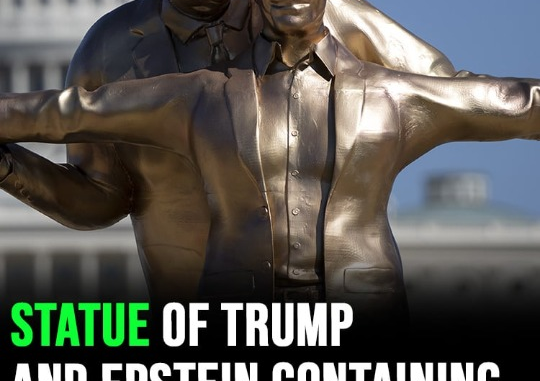
An eye-catching art installation called “King of the World” has stirred significant controversy after being placed near the National Mall in Washington, D.C. The sculpture’s dramatic pose—similar to the iconic moment from the movie Titanic—quickly attracted the attention of tourists, visitors, and political commentators. While some people found the artwork provocative or disturbing, others interpreted it as a critical statement about power, collective memory, and the individuals society chooses to honor.
The piece portrays Donald Trump alongside the late financier Jeffrey Epstein in a stylized, gold-colored sculpture, a creative decision that has intensified the debate surrounding the work. Opponents claim the imagery intentionally mixes satire with political protest, whereas supporters believe it encourages viewers to reflect on influence, responsibility, and the legacy of prominent figures. Its theatrical composition and bright, metallic finish appear designed to draw attention and encourage conversation among those passing by.
Statements attributed to the anonymous art group Secret Handshake indicate that the installation was intended to spark discussion rather than present a single clear message. According to the collective, the artwork examines ideas related to fame, memory, and the complex connection between authority and public perception. By situating the sculpture in such a symbolic national setting, the artists hoped to inspire people to reconsider who becomes celebrated in national stories and for what reasons.
Public reactions have been strongly divided. Some viewers regard the installation as political satire that questions authority, while others consider it inappropriate or disrespectful for a historic public space. Regardless of opinion, the sculpture has clearly succeeded in generating widespread conversation—both among visitors at the National Mall and online—about the role of art in challenging power, influencing historical memory, and addressing difficult aspects of the past.