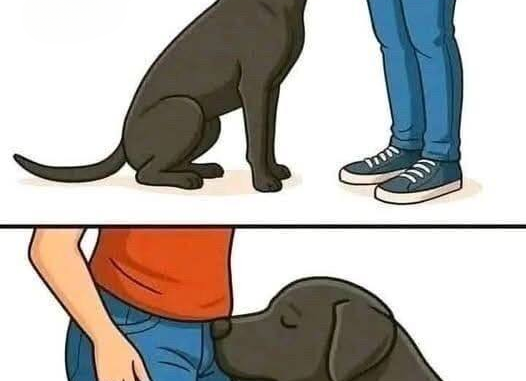
Dogs perceive the world in ways vastly different from humans. While people primarily rely on vision and verbal communication, dogs depend heavily on their sense of smell to interpret their surroundings, understand others, and navigate social dynamics. This reliance on scent explains why dogs often sniff areas humans consider private—a behavior that may seem surprising or awkward but is a natural and informative way for dogs to gather information.
At the heart of this behavior are specialized glands called apocrine glands, found in places like the armpits and genital region. These glands release pheromones—chemical signals that convey details about an individual’s sex, age, reproductive status, stress, and emotional state. To a dog, a sniff functions as a detailed introduction, far more informative than a human handshake or verbal greeting. Dogs’ olfactory systems are extraordinarily sensitive, estimated to be 10,000 to 100,000 times more acute than humans’, enabling them to detect subtle hormonal, emotional, and health changes. Thus, when a dog sniffs your crotch or armpits, it’s not misbehavior—it’s an instinctive way of understanding you.
Sniffing is a core social behavior in canine society. Dogs use scent to communicate identity, hierarchy, and relationships, and they apply the same instinct to interacting with humans. By reading pheromonal and chemical cues, dogs can gauge emotional states, detect stress, and decide whether to approach gently, provide comfort, or keep distance. This ability demonstrates a level of emotional intelligence that often surprises humans.
Sniffing also strengthens the bond between dogs and people. It fosters recognition, attachment, and reassurance, transforming what humans perceive as awkward into a sign of attention and trust. Service and medical alert dogs showcase this skill, detecting changes in blood sugar, hormone levels, or anxiety before their human companions notice. For these dogs, sniffing is both functional and relational, highlighting the profound role scent plays in their behavior.
While natural, some owners prefer to set limits on sniffing. Gentle guidance, rather than punishment, works best. Commands like “sit,” “leave it,” or “come,” reinforced with positive rewards, teach dogs appropriate boundaries without suppressing their instincts. Providing designated sniffing areas, scent-based games, and interactive toys allows dogs to explore naturally while maintaining household comfort.
Sniffing is also a window into canine intelligence. Dogs integrate sensory input with social cues, interpreting complex information to guide their actions. Over time, patterns of sniffing can reflect familiarity and attachment, with dogs revisiting familiar areas of a person’s body as a sign of recognition and trust.
Understanding this behavior encourages a shift in perspective. Instead of viewing it as embarrassing or disrespectful, it can be appreciated as attentiveness, empathy, and communication. Dogs are not guided by human concepts of privacy; their actions are biologically and socially driven. By respecting their instincts, humans can foster deeper bonds and more meaningful interactions with their canine companions.
Pheromones play a crucial role in this perception. Humans release these chemical signals through sweat, particularly from apocrine glands, and dogs detect them using the vomeronasal (Jacobson’s) organ. This enables dogs to distinguish individuals, identify emotions, and even sense health conditions. What may seem like curiosity is actually a sophisticated method of reading social and biological cues.
Dogs’ emotional intelligence is closely tied to sniffing. They can detect stress, fear, happiness, or relaxation through chemical signals, adjusting their behavior to offer comfort or maintain caution. Sniffing acts as social communication, helping dogs navigate relationships, establish trust, and reinforce bonds. New humans may be sniffed more extensively until trust and familiarity develop.
Training can guide sniffing behavior without suppressing it. Positive reinforcement encourages appropriate interactions, while scent-based activities provide mental stimulation and satisfy natural instincts. Sniffing also benefits humans indirectly, as dogs can detect health changes, stress, or anxiety, often acting as early warning signals for conditions that require attention.
Ultimately, sniffing reflects dogs’ sensory awareness, social intelligence, and emotional attunement. It is not disrespect, mere curiosity, or misbehavior, but a sophisticated form of interaction, information-gathering, and bonding. Recognizing this allows humans to approach dogs with patience, appreciation, and guidance, fostering trust and strengthening the unique, enduring connection between humans and dogs.
Dogs’ noses are powerful tools—gateways to understanding, empathy, and connection. What may seem awkward is, from a dog’s perspective, an expression of attention, affection, and intelligence, reinforcing the deep bonds that make the human-canine relationship so remarkable.