I had been married to Mike for seven years.
Seven years built on routines that felt comforting and secure. Quiet Sunday mornings with coffee. Inside jokes no one else would understand. A steady kind of trust I never imagined could fall apart.
Last spring, my grandmother passed away and left me $15,000.
It wasn’t a huge amount, but it meant a lot to me.
I only shared the news with Mike.
I believed we were partners in everything.
He reacted kindly—supportive, even warm.
At least, that’s how it seemed.
A few months later, he came home looking distressed. His face was pale, his energy off.
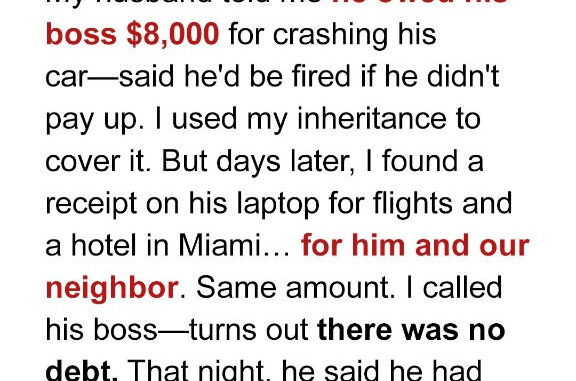
“I had an accident with my boss’s car,” he said. “He wants $8,000 or I could lose my job.”
I didn’t question it.
He was my husband.
Helping him felt natural.
That same evening, I transferred the money, convincing myself I was protecting our life together.
A few days later, I borrowed his laptop to search for a recipe.
That’s when something caught my eye.
A file on the desktop: “Tickets_Miami.pdf.”
A strange feeling crept in.
I opened it.
Two plane tickets.
A hotel booking.
Eight days.
The names listed?
Mike…
And Sarah.
Our neighbor.
Friendly, approachable, always dropping by just enough to feel like part of our circle.
My hands went numb.
I kept scrolling.
The total cost: $7,983.
Almost the exact amount I had given him.
I stared at the screen, my heart pounding.
No… this couldn’t be real.
There had to be another explanation.
A misunderstanding.
So I did the only thing I could think of.
I called his boss.
“Hi, Jim,” I said, trying to stay calm. “I just wanted to check… is everything okay with your car?”
There was a pause.
Then confusion.
“My car? It’s fine. Why?”
My stomach sank.
“So… no accident?” I asked.
“No,” he replied. “Why would there be?”
That was it.
Everything became clear in that moment.
It wasn’t an accident.
It wasn’t confusion.
It was a lie.
A deliberate one.
When Mike came home that evening, he acted completely normal. Relaxed. Almost cheerful.
As if nothing had happened.
“I’ve got a work trip next week,” he said casually. “D.C., just for a few days.”
I smiled, nodded, and pretended to believe him.
Then I waited.
The next evening, I invited Sarah and her husband, Edward, over for dinner.
I made sure everything felt warm and welcoming. Cooked a full meal, set the table nicely, opened a good bottle of wine.
I wanted it to feel ordinary.
So no one would suspect what I was about to do.
The evening began easily—conversation, laughter, the usual comfort.
Then, casually, I said, “Mike was just telling me about his trip next week.”
Edward looked up. “Oh yeah? Where to?”
“D.C.,” I replied.
He chuckled. “That’s funny.”
“Why?” I asked.
“Because Sarah’s going to Miami next week,” he said. “Girls’ trip with her college friends.”
The room fell silent.
Completely silent.
Sarah froze.
Mike’s expression shifted instantly.
I placed my glass down slowly.
“Is she?” I asked calmly.
No one answered.
They didn’t need to.
I stood up, steady and composed.
“Mike,” I said, “I’ll be staying at Jenny’s tonight.”
He rushed to respond, but I was already walking away.
I didn’t cry.
Not then.
The truth was too clear, too final.
There was nothing left to question.
The days that followed were a blur—lawyers, finances, conversations I never expected to have.
Mike tried to explain, to downplay everything.
“It didn’t mean anything,” he said. “I was going to tell you.”
But nothing he said could undo it.
Not the affair.
Not the deception.
Not the way he used my trust.
As for the money—I made sure he returned every cent.
Not because I needed it.
But because he needed to understand the cost of what he’d done.
Weeks later, he came to see me at Jenny’s.
He looked worn down, diminished somehow.
“I made a mistake,” he said quietly. “The biggest of my life.”
I believed him.
His regret was obvious.
But regret doesn’t rebuild trust.
And it doesn’t erase betrayal.
“I hope you learn from it,” I told him.
His voice broke. “Is there any chance—”
“No,” I said softly.
Not out of anger.
Not out of bitterness.
But certainty.
Because sometimes the hardest part isn’t losing something.
It’s realizing you were the one who threw it away.
And now you have to live with it.