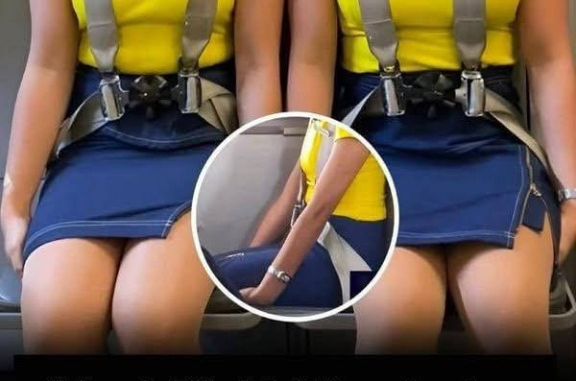
If you’ve ever taken a commercial flight, you may have noticed something unusual: flight attendants sometimes sit with their hands tucked under their thighs during takeoff and landing. Although it might look strange at first, this behavior is actually related to safety procedures designed to protect both the crew and the passengers.
Flight attendants are responsible for much more than serving drinks and assisting travelers. They receive extensive training to handle emergencies and ensure the safety of everyone on board. Part of that training includes following specific procedures during the most critical phases of a flight.
One of these procedures involves a particular brace position that cabin crew members take while seated in their jump seats during takeoff and landing.
Henny Lim, a flight attendant working for the Philippine airline Cebu Pacific, explained this lesser-known safety measure in a TikTok video that attracted a lot of attention online. In the video, she asks viewers if they have ever wondered why cabin crew sit in a certain way during those moments of a flight. She then demonstrates the brace position used by flight attendants.
Takeoff and landing are considered the phases of a flight when incidents are statistically more likely to occur. If an emergency evacuation becomes necessary, the brace position helps the crew remain protected and ready to react quickly.
The position involves fastening the seatbelt securely, sitting upright, placing the feet flat on the floor, and positioning the arms in a controlled way—often resting on the thighs with thumbs tucked in and the arms relaxed.
In the video, Henny and another crew member demonstrate how some flight attendants place their hands underneath their thighs while sitting in the jump seat. This method helps keep the arms stable and prevents sudden movements that could happen because of turbulence, a hard landing, or unexpected jolts. Keeping the arms steady can help crew members react more efficiently if something unexpected happens.
The purpose of the position is to keep the body as steady as possible so that, in the event of an impact, there is less movement and therefore a lower chance of injury. Limiting movement can help protect the crew so they can immediately assist passengers if an emergency occurs.
During this time, flight attendants also perform what is known as a “silent review.” This means they mentally go over the steps they would take in different emergency situations while the aircraft is taking off or landing.
Before the video ends, the message wishes passengers a safe flight.
However, some experienced flight attendants have pointed out that sitting directly on their hands is not necessarily an official requirement. In an interview with Reader’s Digest, a long-time flight attendant explained that the important rule is simply to keep the hands positioned properly as part of the brace posture.
Erin Thomas, who has more than 15 years of experience as a flight attendant, explained that the most important instruction is not to grab the safety harness during these moments. The brace position itself is what matters most.
She personally prefers resting her hands calmly on her lap because it helps her appear relaxed. According to her, passengers often notice the body language of the crew, and if flight attendants look calm during takeoff, travelers are more likely to feel calm as well.
Although the posture might seem strict or unusual, it plays an important role in protecting crew members from injury and ensuring they are ready to help passengers immediately if a situation arises.
Many travelers may have noticed this behavior without knowing the reason behind it. Now that you understand the purpose, it offers a new perspective on the careful safety routines followed by cabin crews on every flight.