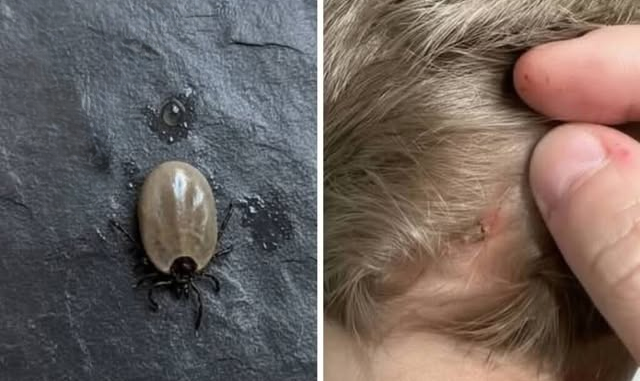
The moment a parent discovers an unfamiliar insect hidden among the soft strands of a child’s hair can instantly trigger alarm. It usually happens during ordinary routines—brushing hair after a bath, styling it before school, or relaxing together at home. Suddenly, a small movement catches the eye: a tiny dark speck that clearly doesn’t belong. In that brief moment, worry often takes over. Thoughts race through the mind: Could it be a tick? Is it lice? Has something spread around the house?
Although the first reaction might be to reach for strong treatments or seek urgent medical help, the most helpful response is to remain calm and observe carefully. The scalp is a sensitive and personal area, so discovering an insect there can feel unsettling. However, approaching the situation calmly and methodically allows parents to turn panic into practical action. In most cases, finding a bug in a child’s hair is not a medical emergency—it is simply a manageable situation many families encounter.
The first step is identifying what the insect actually is. In most situations, the discovery falls into one of a few common categories, and each one requires a slightly different approach.
One of the most frequent culprits is head lice. These tiny insects are especially common among school-aged children. About the size of a sesame seed, they are wingless and usually light brown or gray. Unlike fleas or other insects, lice cannot jump or fly; they crawl quickly along hair strands. They rely on the human scalp for survival and typically die within a couple of days if separated from their host. Often, the most noticeable sign of lice is not the insect itself but the presence of eggs, known as nits. These small oval eggs are firmly attached to the hair shaft with a sticky substance and cannot be brushed away like dandruff. They are most commonly found behind the ears, near the crown of the head, and along the back of the neck.
Another possible discovery is a tick. Ticks behave differently from lice because their goal is to attach directly to the skin and feed. They usually appear flat and oval-shaped with eight legs, although they may look larger and grayish if they have already started feeding. If the insect is firmly attached to the skin and does not move when touched, it may be a tick. The concern with ticks lies in the small risk of transmitting certain illnesses, including Lyme disease. While most tick bites do not lead to infection, removing them properly is important to minimize potential problems.
Sometimes, however, the insect turns out to be nothing more than a harmless visitor. Children often play outdoors, roll in the grass, climb trees, and explore their surroundings. As a result, insects such as ants, beetles, or small spiders can occasionally end up in their hair by accident. If only one insect is present and there are no eggs or signs of irritation on the scalp, it is likely just a temporary guest that can simply be washed or brushed away.
Many parents believe that itching is the first sign of lice, but this is not always true. The itching sensation is actually caused by an allergic reaction to the saliva lice release when feeding, not by the insects themselves moving on the scalp. Because this reaction can take time to develop, a child may have lice for several weeks without any noticeable itching. This is why occasional scalp checks can be more reliable than waiting for symptoms to appear.
When an insect is found, it is important to handle the situation calmly. Children are quick to sense their parents’ emotions, and reacting with panic may make them anxious as well. Treating the situation as a simple grooming task or even a small science experiment can help keep the atmosphere relaxed.
If the insect is moving freely, it can be gently removed using tweezers or a tissue. Placing it in a sealed container or small bag can be helpful if you want to show it to a healthcare professional or school nurse for identification. If the insect is attached to the skin and appears to be a tick, fine-tipped tweezers should be used to grasp it as close to the skin as possible. Pulling upward slowly and steadily is the safest way to remove it. Twisting or jerking the tick should be avoided, as this can leave parts of it embedded in the skin. After removal, the area should be cleaned with soap and water or rubbing alcohol.
In recent years, approaches to lice treatment have changed. Some lice populations have developed resistance to common chemical treatments, leading many experts to recommend more physical methods of removal. One widely recommended technique is wet combing. In this method, a thick layer of conditioner is applied to damp hair to slow down the lice and prevent them from moving quickly. A fine metal nit comb is then used to carefully comb through the hair in small sections from the scalp to the ends. After each pass, the comb is wiped on a white paper towel to check for lice or eggs.
Repeating this process every few days for about two weeks helps ensure that any newly hatched lice are removed before they can mature and lay additional eggs. This timing matches the life cycle of the insects and makes the process far more effective.
Discovering a bug in a child’s hair is something many parents experience at least once. It does not mean the home is unclean or that anyone has done something wrong. Childhood involves close contact with other children and plenty of outdoor play, which naturally increases the chances of these encounters. By staying calm, identifying the situation correctly, and following a simple plan for removal, parents can handle the problem without unnecessary stress. In doing so, they also show their children that even small and uncomfortable surprises can be managed with patience and confidence.