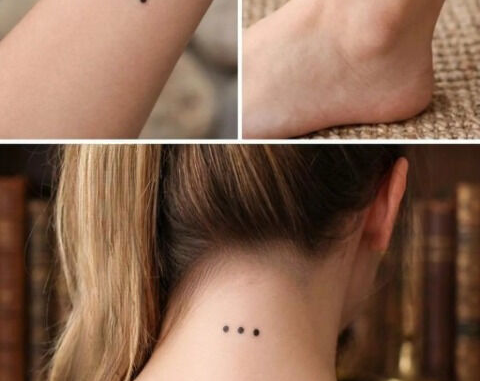
At first glance, a three-dot tattoo may seem simple and understated, but its very simplicity is what gives it depth and adaptability. Often placed in discreet spots—between the thumb and forefinger, along the knuckles, or near the eye—these small marks can carry a wide range of meanings depending on personal, cultural, or social context.
One common interpretation draws on the “Three Wise Monkeys” principle: see no evil, hear no evil, speak no evil. In this sense, the tattoo can symbolize mindfulness, self-restraint, or a conscious choice to avoid negativity, serving as a personal reminder to act thoughtfully.
For others, the three dots signify loyalty, unity, or belonging, acting as a subtle sign of shared identity within a group. Some assign highly personal meanings, marking life stages, struggles, or journeys of growth and resilience. They might represent past, present, and future, or reflect a simple philosophy: “my life, my journey.”
Context plays a major role in interpretation. In some cultures, the tattoo may represent philosophical principles, while in others it could be tied to specific subcultures, sometimes causing misunderstandings. Its meaning is rarely fixed—it is shaped by the wearer, placement, and life experiences behind it.
Placement adds further nuance. Visible spots like the hand suggest openness, while hidden areas convey private significance. The minimalist design ensures the symbol remains relevant over time, evolving alongside the wearer. Its subtlety invites reflection rather than immediate judgment.
Ultimately, the three-dot tattoo shows that even the simplest designs can hold profound significance. Whether expressing personal philosophy, group identity, or life experiences, it demonstrates that minimalism can carry enduring meaning, growing with the individual over time.