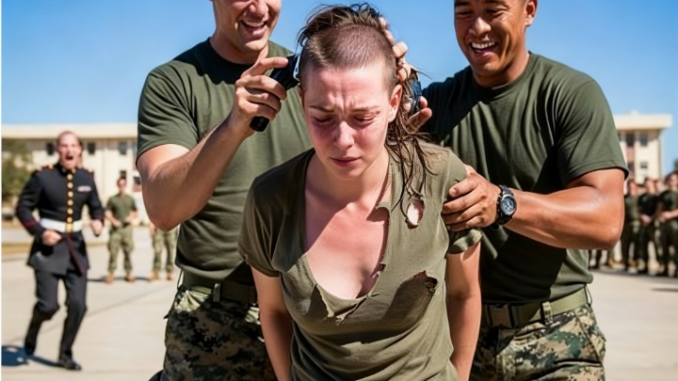
They shaved her head while they laughed.
Not because of discipline.
Not because of any regulation.
Simply because they thought it was funny.
Under the harsh Nevada sun at Camp Riverside, clippers buzzed loudly as thick strands of dark hair fell to the ground. Recruits stood stiff in formation, boots dusty, eyes forward. No one spoke. No one dared move.
Sergeant First Class Tyson Krueger stepped closer, his voice dripping with mockery.
“Basic training builds character,” he sneered. “Let’s see how strong yours is when the mirror stops helping.”
Private Mara Brennan kept her gaze fixed ahead. Her jaw tightened, shoulders firm. She didn’t react as hair slid down her neck and landed on the hot concrete.
But behind that calm exterior, Lieutenant Colonel Evelyn Thorne—an Army Intelligence officer with two decades of experience—was quietly observing everything.
Every smirk.
Every whisper.
Every phone subtly raised to capture the humiliation.
That was exactly why she had been sent.
Camp Riverside was supposed to be one of the Army’s top training sites. Instead, it had become the center of troubling rumors. Anonymous reports to investigators described hazing, falsified records, missing equipment, and recruits who mysteriously vanished from paperwork after injuries. Yet every official inspection declared the camp clean.
So command chose a different tactic.
They removed Evelyn’s rank.
Stripped away her authority.
And placed her inside the system disguised as a vulnerable recruit.
Krueger ruled the camp like it belonged to him. Punishments were labeled “conditioning.” Complaining recruits were quietly reassigned. Reports were edited before dawn. On paper, everything looked perfect—so higher command never looked too closely.
After the head-shaving incident, Mara was assigned sixteen straight hours cleaning latrines with no rest, water break, or medical check. When she collapsed from heat exhaustion, Krueger simply recorded it as “voluntary overexertion.”
Evelyn memorized the falsified report.
That night, her freshly shaved scalp stinging against the pillow, she tapped once against the metal bunk frame—a habit from years of covert work. Beyond the base, encrypted messages were already moving through secure channels.
Krueger didn’t understand one simple truth:
Sometimes predators disguise themselves as prey.
The following morning, recruits lined up again in formation. A black government SUV rolled past the gate slowly without stopping. No announcement. No meeting request.
Just a quiet pass.
Krueger stiffened at the sight.
Because authority that doesn’t introduce itself often means oversight that doesn’t need permission.
For Evelyn, it meant patience.
Over the next three weeks, the pressure inside the camp grew. Krueger reacted the only way he knew—by tightening his grip. Night drills without authorization. Extended punishments. Altered medical reports. Injuries labeled as weakness.
Evelyn volunteered for the worst tasks—night watch, equipment checks, perimeter cleaning.
In darkness she recorded conversations between staff discussing equipment transfers. She photographed stacks of supposedly “damaged” gear that were clearly brand new. She tracked vehicles visiting a warehouse near the outer fence.
One evening she followed Corporal Hayes to a dim storage building. Inside were pallets of combat gear marked for disposal.
None of it was damaged.
Hayes spoke freely, assuming a recruit wouldn’t understand supply codes.
“Krueger’s covered,” he said casually. “Brigade approved. Shipment goes out Friday.”
Evelyn remained perfectly calm. Every word was recorded.
Her greatest risk wasn’t discovery.
It was surviving long enough to finish the mission.
Another recruit named Jensen broke a rib during unauthorized sparring. When he threatened to report it, he was transferred within hours. His paperwork vanished.
Camp Riverside wasn’t just abusive.
It was organized.
People, money, and silence all moved through the system smoothly.
Then everything reached a breaking point.
During a night navigation drill, Krueger shoved Mara hard enough to reopen the razor burns on her scalp. Blood trickled down her temple.
“You think you’re better than us?” he hissed. “You’re nothing here.”
Evelyn met his gaze calmly.
“No, Sergeant,” she replied quietly. “I’m exactly what you deserve.”
Later that night, a small vibration pulsed inside her boot where a concealed device rested.
Signal received. Extraction soon.
Two days later, another trainee collapsed during prolonged heat drills.
Official report: cardiac failure.
Actual cause: untreated heatstroke.
Krueger ordered silence. But someone leaked footage.
At sunrise, the entire base was suddenly placed under lockdown.
Then the black SUVs returned.
Not just one.
A convoy.
Major General Robert Hensley stepped onto the parade field accompanied by investigators and military lawyers. Krueger shouted commands, but no one moved.
The general’s voice cut through the silence.
“Lieutenant Colonel Evelyn Thorne. Step forward.”
For a moment, time seemed to freeze.
Private Mara Brennan stepped forward from the ranks.
She delivered a sharp salute.
“Sir,” she said calmly. “Evidence collection complete.”
Krueger’s face turned pale.
Handcuffs were on his wrists before he could finish protesting.
Barracks were sealed. Offices searched. Phones confiscated.
Within hours, Camp Riverside was shut down.
The investigation moved quickly. Evelyn presented detailed evidence: altered injury reports, illegal equipment transfers, suppressed complaints. Recordings were played. Photographs displayed. Financial records examined.
What shocked commanders most wasn’t just Krueger’s brutality.
It was how comfortable everyone had become with it.
A captain approved false training hours.
A major ignored medical warnings.
A colonel signed evaluations without ever inspecting the barracks at night.
Corruption didn’t grow from chaos.
It grew from convenience.
Court-martial hearings followed. Evidence dismantled every defense. Former trainees testified with shaking voices that held firm.
Krueger was convicted of assault, obstruction, and fraud. His military career ended permanently.
Several officers lost their commands. Others accepted plea deals.
Camp Riverside was closed while the Army rebuilt the training program.
Weeks later, Evelyn addressed a group of new recruits at another facility.
They stood when she entered—not only for her rank, but out of respect.
“I wasn’t sent here to punish,” she told them. “I was sent to make sure the system answers to the people it serves.”
A recruit raised a hand.
“Ma’am… why didn’t you stop it earlier?”
Evelyn considered the question.
“Because real reform requires evidence,” she answered. “And evidence takes time.”
Later she reviewed transfer files and found Jensen’s name.
Within days his medical record was corrected, his discharge reversed, and his benefits restored.
The trainee who died was officially recognized as having fallen in the line of duty. His family finally received acknowledgment.
Months later, a new training program began in Nevada with stronger oversight, anonymous reporting systems, and surprise inspections.
Evelyn quietly returned to intelligence work.
On her final morning at the base, she stood alone on the parade field as the sun rose.
A young soldier approached hesitantly.
“Ma’am… I heard what you did.”
Evelyn gave a small smile.
“You heard wrong,” she said. “I just did my job.”
The soldier shook their head.
“You reminded us what the uniform means.”
Evelyn watched them walk away.
Her hair had grown back short and even.
Rank can be taken away.
Hair can be shaved.
Silence can be forced.
But accountability outranks them all.
And long after Camp Riverside disappeared into reports and reforms, one truth remained clear:
Authority without integrity never lasts.
But integrity itself is a kind of power.