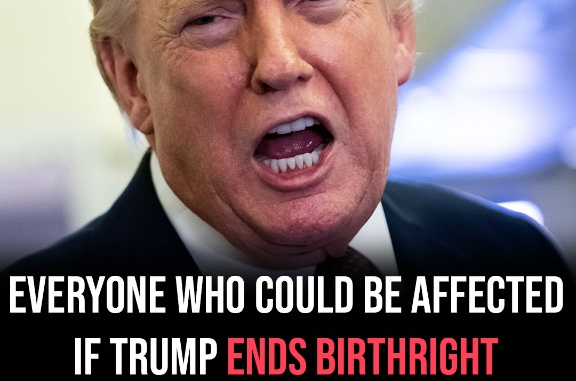
In a move that has ignited debate across the nation, the very definition of what it means to be “American” is facing an unprecedented challenge. On April 3, 2026, Donald Trump advanced a highly controversial executive order aimed at ending birthright citizenship. While much of the public discussion has focused on undocumented immigrants, the implications are far broader: this order could potentially deny citizenship to millions of children born on U.S. soil to legal residents, international students, and skilled workers living temporarily in the country.
For more than 150 years, the 14th Amendment has guaranteed that anyone born in the United States is a citizen. As Connecticut Attorney General William Tong put it, “Period. Full stop.” The new executive order, however, seeks to bypass this constitutional guarantee, preventing children from automatically acquiring citizenship if their parents are in the country unlawfully—or even if they are on temporary legal visas. This could affect infants born to H-1B workers from India, graduate students from Canada, or visiting families from the UK.
The magnitude of this shift is staggering. According to Pew Research, roughly 1.2 million U.S. citizens were born to undocumented immigrants in 2022 alone. Under the proposed order, many could be rendered stateless or forced to take their parents’ nationality, potentially leaving them disconnected from the country they were born in. The effects extend to thousands of legal visa holders as well, whose children may no longer enjoy the automatic rights traditionally associated with American birth.
Legal opposition has been swift and intense. Attorneys general from 22 states have filed lawsuits, asserting that a president cannot unilaterally override the Constitution. The matter has now reached the U.S. Supreme Court, which began hearing arguments this week. In a historic first, President Trump attended the proceedings in person.
The rhetoric surrounding the policy has been fiery. On Truth Social, Trump defended the measure, claiming that birthright citizenship has been exploited by wealthy foreign nationals seeking to secure U.S. citizenship for their children. He argued that the 14th Amendment was originally intended only for children born to formerly enslaved people after the Civil War, not as a universal guarantee. “The world is laughing at how our court system has become,” he declared, framing the issue within his broader vision of national sovereignty and economic protectionism.
As the Supreme Court deliberates, millions of families are left in uncertainty. A ruling in favor of the executive order would mark the most substantial restriction of American civil rights in recent history, creating a hierarchy where a child’s rights depend on their parents’ immigration status. For parents expecting children on U.S. soil, citizenship is no longer automatic—it has become uncertain. The outcome could reshape the nation’s identity, challenging the very idea of the United States as a “Melting Pot” for generations to come.