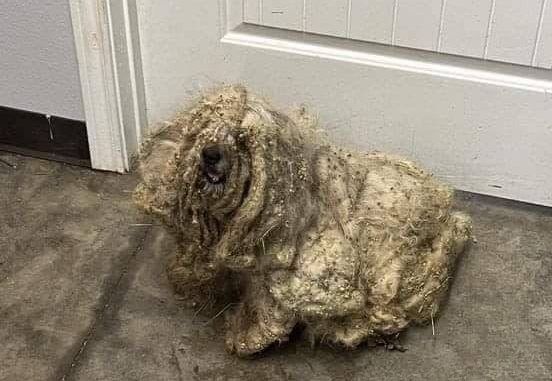
They discovered him at the side of a road, hardly distinguishable as a dog—more like a fading outline beneath years of neglect. The burden he carried was not only physical but the accumulation of time itself, hardened into thick layers that hid the animal beneath. His fur had grown into a heavy, matted mass, and a collar deeply embedded in his neck suggested a past of ownership long turned into abandonment. Naming him Matt was intentional. It was a way of recognizing him, not erasing his history, but allowing him to move beyond it.
What followed was a slow, careful process of restoration rather than a dramatic rescue. Under anesthesia, the years of neglect were gently stripped away, each removal uncovering not just skin and structure, but evidence of endurance. When he finally stood, unsteady and fragile, it marked more than a physical recovery—it was the first moment of a life he had been denied. That quiet instant carried profound meaning: something irreversible had begun to shift.
Now in foster care, Matt is gradually learning what safety feels like in small, unfamiliar ways. Gentle contact no longer brings harm. Rest is possible without fear. Food arrives without struggle. These ordinary experiences are entirely new to him, and his healing unfolds slowly, without urgency, in steady, patient steps.
Matt’s story begins where survival ends. A life once defined by persistence is now opening toward possibility. He moves forward quietly, as if beginning to understand that enduring was only the first chapter—and living is something he is finally being given the chance to learn.