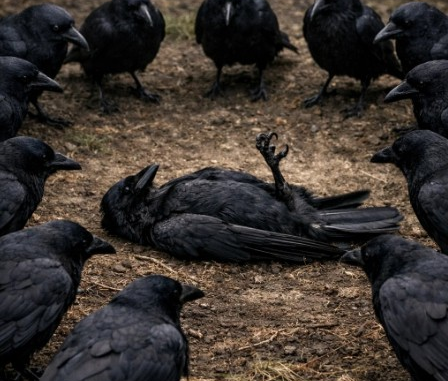
When a crow comes across another that has died, it doesn’t immediately move on. Instead, it calls out, drawing others to the scene. Soon, more crows gather, observing carefully and becoming highly alert. What may resemble mourning is, according to researchers, more about learning than grief. These “crow funerals” seem to function as moments of collective awareness, where the birds study their environment and identify possible threats.
Crows are highly intelligent creatures, capable of recognizing human faces, remembering danger, and sharing warnings within their groups. When they gather around a fallen member, they are not expressing emotion in a human sense, but actively collecting information that can help them survive in the future. It is intelligence that operates both individually and collectively.
This behavior offers an interesting contrast to how humans often respond to discomfort. People tend to avoid or ignore difficult situations, while crows remain present and attentive. They observe together, turning a disturbing event into shared understanding rather than avoidance.
In this way, their behavior reflects a deeper form of intelligence—one based on awareness, communication, and learning from experience. It highlights that survival is not only about instinct or strength, but also about attention, memory, and the ability to pass knowledge through a group.