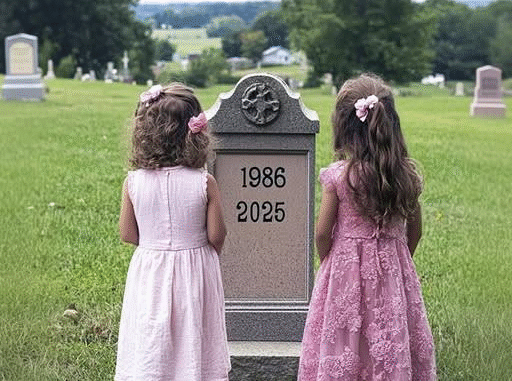
On the morning of Brian’s birthday, the world seemed painfully still. The sky was bright and calm, but to Linda and her daughters, everything felt unbearably heavy. Grief had settled into every corner of their home, and for months it had followed them like a quiet shadow.
Isla, only six, longed for the little bits of fun her father used to bring—the secret cookie he’d sneak her while Linda pretended not to notice. Eight-year-old Madison, more perceptive than her age suggested, missed the sound of his laugh, the one that made her feel safe. Linda missed all of it. But the memory of Brian’s final days—cancer slowly and cruelly taking him—tormented her most.
The night before he died, Brian had asked the girls to curl up beside him in his hospital bed. He held their hands and whispered promises he knew he wouldn’t be able to keep. “On my birthday,” he had told them, “wear your prettiest dresses and come show me.” It was a request only a dying father could make—one meant to give his children something comforting to hold on to.
The girls remembered the promise, even when Linda, exhausted by grief, didn’t.
When they reminded her, she hesitated. Buying dresses felt like moving forward without him. But Madison cupped her mother’s face and said softly, “Mom, Dad didn’t want us to be sad forever. We need to do this.” And that gave Linda the strength she thought she’d lost.
She took them shopping. Isla twirled in every mirror while Madison chose her dress with thoughtful care, wanting to pick the one her father would have loved. Linda tried to stay strong, but tears still escaped as she paid. Grief rarely leaves quietly.
The next morning, the girls walked toward Brian’s grave in their new dresses, hands intertwined. Linda followed with a bouquet, her heart tight but determined. Sometimes, simply showing up is an act of courage.
At the gravestone, Isla suddenly gasped.
Two neatly wrapped boxes sat before Brian’s headstone, each labeled with a girl’s name and a small sticker reading: From Daddy.
Linda froze. She had placed the gifts there the night before, hoping they would soften the pain. But seeing them in the morning light hurt more than she expected.
“Daddy must’ve missed us!” Isla giggled. “He sent us presents!”
Madison, older and wiser, looked at her mother with quiet gratitude.
“Go ahead,” Linda whispered. “Open them.”
The girls peeled the wrapping carefully. Inside each box was a pair of Mary Janes—pink for Isla, lavender for Madison—and a letter in Brian’s handwriting. The sight of the familiar lettering nearly brought Linda to her knees.
Isla squealed over her shoes. Madison unfolded her letter with trembling hands.
“Daddy says I’m pretty,” Isla beamed. “And he loves me infinity!”
Madison’s eyes filled as she read her own letter. Then she pulled her sister close. “Daddy wants us to smile again. He says he sees us. And he’s happy when we’re happy.”
Linda covered her mouth, letting them read in peace. She had spent hours crafting those letters, carefully copying Brian’s handwriting from old cards. It was something she never imagined herself doing—creating comfort from a man who could no longer give it. But seeing their faces now, she wondered if she had done something right.
The letters were simple but filled with warmth. Brian teased them about stealing cookies, told them to keep being playful, and reminded them that he would always be with them—just not in a way they could see. “You don’t have to be perfect,” he wrote. “You just have to be my girls. And I’m proud of you every day.”
When Madison finished, she wrapped her arms around her mother. “Thank you,” she whispered. “For bringing us here. And for helping Daddy…even now.”
Linda held her tightly. “I love you. Both of you.”
She realized then that grief had taken pieces of her without her noticing—pieces her daughters were quietly helping her reclaim.
They spent the rest of the morning sitting in the grass, sharing stories about Brian: how he always burned pancakes on Sundays, how he once filled the bathtub with bubbles just to make the girls laugh. They stayed until the sun warmed the air.
Before leaving, the girls rested their hands on the gravestone and whispered, “Happy birthday, Daddy.” Linda finally felt steady enough to whisper it too.
On the walk back to the car, Madison slipped her hand into her mother’s. “Mom,” she said softly, “Dad would be proud of you.”
And for the first time in months, Linda believed it.
What they learned—what every family learns—is that love doesn’t disappear with death. It lingers in memories, in small gestures, in the way children smile like their father or the way a mother still sets an extra place out of habit.
Grief changes. Love doesn’t.
And with their new shoes and their father’s words tucked safely into their hands, Isla and Madison walked away from the grave knowing one thing with certainty:
Their father was gone.
But he had never truly left.