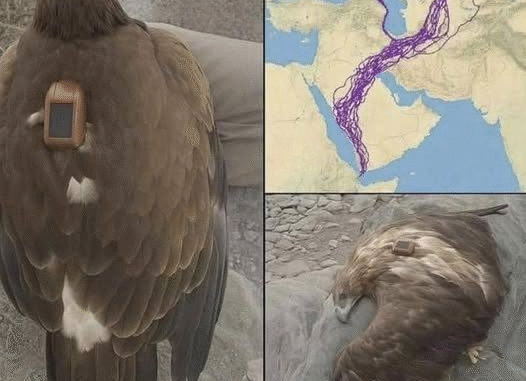
For twenty years, an extraordinary steppe eagle embarked on a journey that captivated scientists and nature enthusiasts worldwide. Tracked by GPS from Russia to its final resting place in Saudi Arabia’s Valley of the Child, the bird revealed not only impressive endurance but also a remarkable, instinct-driven intelligence shaped by evolution and environmental realities.
Although the eagle traveled thousands of kilometers across deserts, mountains, and multiple countries, the most striking aspect of its migration was its strategic routing. Instead of flying straight across vast bodies of water, it consistently chose longer routes over land. This behavior reflects a key survival strategy: eagles depend on thermal currents—rising warm air over land—to soar efficiently. Because such thermals rarely form over open water, crossing seas would require exhausting, energy-intensive flight that could prove deadly. By instinctively avoiding these risks, the eagle demonstrated a sophisticated understanding of its environment.
When researchers mapped the bird’s movements, its path traced coastlines, mountain ranges, and continental contours. Each detour illustrated its ability to “read” the landscape and follow the safest, most efficient routes. This natural wisdom highlights an important truth: survival relies not just on strength, but on strategy and adaptation.
The eagle’s story also emphasizes why birdwatching inspires so many people. With 9,000–10,000 bird species on Earth—each shaped by unique evolutionary pressures—the diversity of avian behavior offers endless fascination. From agile forest birds to powerful raptors, each species reflects millions of years of adaptation and ecological balance.
Beyond being a scientific marvel, the eagle’s journey carries broader lessons. Its careful navigation mirrors qualities essential in human life: resilience, thoughtful decision-making, and awareness of one’s surroundings. Just as the eagle depends on environmental cues, people thrive when they understand and work with the conditions around them.
Modern tracking technology has made such discoveries possible, providing insights crucial for conservation. By studying migration routes, scientists can protect habitats and better understand threats facing migratory species.
Across cultures, eagles symbolize strength, vision, and endurance. This steppe eagle’s two-decade journey reinforces those associations—a reminder of nature’s quiet intelligence and the resilience woven into every living being.
In the end, the eagle’s story is more than a record of migration. It is a testament to adaptation, instinct, and the profound lessons that the natural world offers to those who take the time to observe it.