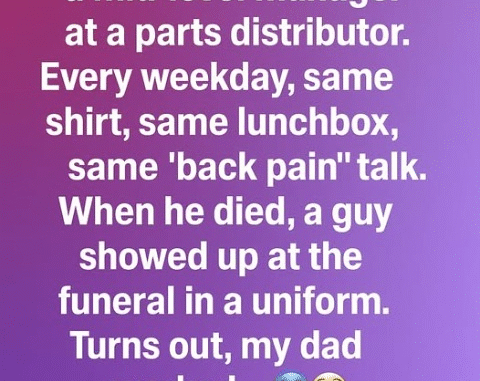
My dad lived such a quiet, predictable life that it was easy to accept everything he told us. Every morning he left wearing the same shirt, carrying the same old lunchbox, complaining about his “back acting up.” He said he was a mid-level manager at a parts company—nothing exciting, nothing stressful. We never questioned it.
When he passed away, the funeral was small. Then a man in a work uniform arrived, staying at the back until things calmed. He introduced himself as my dad’s supervisor—but the job he described wasn’t the one we’d known. My father wasn’t a manager at all. He was the maintenance worker who kept the entire facility running—fixing machines, solving emergencies, doing the tough jobs no one else could.
“He saved our day more times than I can count,” the man said. Those words completely shifted how we understood Dad’s life.
He hadn’t lied out of shame. He just didn’t want us to look down on him the way society sometimes looks down on manual workers. He thought a simple title would make us proud, never knowing the truth was far more admirable.
While sorting his things later, we found his real work jacket—worn, stained, and stuffed in a storage box. In the pocket was a note in his handwriting: “Do good work. Leave things better than you found them. That’s enough.” That tiny message explained his entire life.
He never needed recognition. He lived by effort, consistency, and humility. The stories we heard from his coworkers confirmed it—how he fixed disasters, helped new employees, gave up bonuses so others could have one, and did it all quietly.
Everything clicked: the late nights he blamed on “meetings,” the tools in the garage, the constant back pain. He’d been working hard in ways we never knew.
Visiting his workplace showed us just how much he meant to people. Everyone had a story about something he did that made their lives easier. He never told us any of it. He didn’t want us to worry.
In the end, my dad didn’t leave behind a fancy résumé. He left a legacy built on character—on doing good work without needing applause, on helping people, on humility. He taught us that dignity isn’t found in a title, but in the heart and effort behind the job.
His worn jacket and that small handwritten note are the truest reflection of who he was—and the greatest lesson he ever left us.