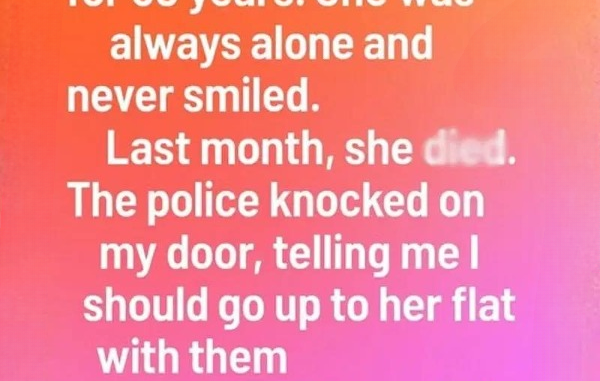
For as long as I lived in that building, I knew her only as the quiet woman upstairs. She moved through the hallways like a soft shadow, never lingering, never inviting conversation. She rarely smiled, never had visitors, and kept her distance from neighborly chatter. Whenever we met on the stairwell, she’d give a polite nod and retreat into her silence. To everyone else in the building, she was simply the lady on the eighth floor — solitary, withdrawn, and wrapped in a mystery we all accepted without questioning.
So when the police knocked on my door a week after she passed, I assumed they had the wrong apartment or were gathering general information. Instead, an officer asked if I was listed as her emergency contact. I couldn’t process the words at first.
Her emergency contact? Me? We had barely exchanged ten sentences in all the years we lived one floor apart.
But the paperwork confirmed it. My name. My address. My phone number. She had chosen me.
They asked if I would accompany them into her apartment to make sure everything was in order. Stepping inside felt like entering a world I never knew existed. The air was still, the kind of stillness that comes from a life lived quietly. Yet the room wasn’t cold or empty — everything felt placed with intention.
Then I noticed the walls.
They were covered in framed drawings — crayon hearts, uneven stick figures, lopsided houses, childish flowers. They were mine. Drawings I made when I was six or seven, the little doodles I used to slide under her door because she always seemed lonely. I never knew if she looked at them. I assumed she threw them away. But she hadn’t. She had framed them — every last one — and hung them like prized pieces in a gallery.
A heavy tightness filled my chest. I stood there looking at pieces of my childhood I had long forgotten, preserved more tenderly by her than by me.
The officer kept talking, but his voice faded as I stepped farther inside. The woman I thought I knew — aloof, detached — shifted in my mind. She wasn’t uncaring or cold. She was private… deeply private… but clearly not untouched by small gestures of kindness.
Under an old chair sat a shoebox filled with postcards, thank-you notes, and handmade holiday cards. My handwriting kept appearing — the small notes I used to leave in the mailboxes around the building during Christmas, the cheerful messages I wrote as a teenager. She had saved every single one.
Another envelope held a school newsletter with my name circled. Old photos from our building’s summer barbecues were worn at the edges, as if she had thumbed through them many times. As I moved through her belongings, it dawned on me: while I barely noticed her over the years, she had been quietly watching my life unfold.
The officer explained that she had no close family left. No living parents, no siblings, no children. After decades in the building, I was the only person she had ever listed as a contact. All because a little kid once pushed colorful drawings under her door.
That understanding sat heavy in my chest. To her, those childish scribbles weren’t nothing. They were connection. They were proof someone saw her. They were reminders she mattered.
Room by room, more details of her hidden life came into view — stacks of mystery novels, unused knitting supplies, the quiet habits of someone who kept herself company. On the kitchen counter lay an unfinished letter addressed to me. Only two sentences were written:
Thank you for always being kind without asking for anything. I wanted you to know you made a difference.
Her pen had stopped mid-sentence.
I sank into her small dining chair, overwhelmed. We often assume people who stay quiet prefer it that way. Sometimes they do. But sometimes their silence is simply the sound of someone waiting — hoping — to be seen.
For years, I assumed she didn’t want connection. All the while she had been collecting the tiny kindnesses I had long forgotten.
Her world wasn’t empty. It was filled with fragile reminders of the moments she felt noticed.
When I finally left her apartment, I couldn’t shake the sense that she had entrusted me with her last chapter. Not out of obligation, but out of trust — the kind of trust built from small gestures that echo for a lifetime.
In the days that followed, I sorted her things with far more care than I expected. I kept the shoebox of drawings. I kept the unfinished letter. And I kept one framed picture — a simple crayon heart with “Have a nice day” scrawled beneath it in my seven-year-old handwriting.
It hangs in my living room now, a reminder of what I only learned much later: you never know how deeply a small act of kindness might reach. What felt insignificant to me had warmed an entire lifetime for a woman who often went unnoticed.
I think of her often — of the silence I misunderstood, of the moments she cherished quietly, of how many people move through the world hoping for just one person to see them.
She taught me something without ever speaking it aloud: notice the quiet ones. The ones at the edges. The ones who rarely ask for anything.
They often carry more love than they show.
And sometimes, they’re waiting for the smallest kindness — because even the tiniest gesture can ripple through a life in ways we never imagine.