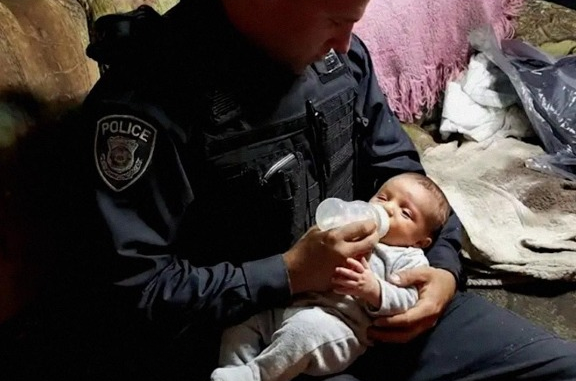
The call came in at 2:17 a.m.—one of those dead-quiet hours when a whole city seems to be holding its breath. I figured it would be another routine welfare check in a rundown building I knew far too well. But when I stepped into that icy apartment and heard a newborn crying like his life depended on it, I didn’t realize I was walking into the moment that would alter the next sixteen years of my world.
At the time, I was Officer Trent—thirty-two, moving through life on autopilot after losing my wife and baby daughter in a house fire two years earlier. Grief hadn’t just wounded me; it had rewired every instinct. I lived in a state of constant anticipation, always bracing for the next heartbreak.
So when dispatch sent us to the Riverside Apartments—decay, danger, and hopelessness stacked in concrete—I felt something shift in my gut. Not dread exactly, but the sense that something was about to land squarely in my hands.
The front door barely clung to its hinges. The stairwell stank of mildew. And then we heard it—an infant’s panicked wail slicing straight through the third-floor darkness. The apartment door hung ajar. Inside, a woman lay unconscious on a filthy mattress, breaths faint and shallow. In the corner, abandoned on the wooden floor, was a baby—no more than four or five months old—shivering in a dirty diaper.
The second I saw him, my training vanished. Instinct took command. I told my partner, Riley, to call for medics and social services, then scooped the tiny boy into my arms. He clung to my shirt with desperate strength. I muttered, “You’re okay. I’ve got you,” though my voice cracked under the weight of it.
A half-empty bottle sat nearby. I checked the formula, tested it against my wrist the way I once had for my daughter, and fed him. He drank like he hadn’t eaten in days. And in that moment, something inside me shifted—a mix of memory, ache, and purpose I hadn’t felt in years.
Paramedics stabilized the mother—dehydrated, starved, barely conscious. They loaded her onto a stretcher. When I asked what would happen to the baby, they said he’d go into emergency foster care. He was asleep against my chest by then, trusting me with a trust he had no reason to give. For the first time in two years, something inside me stirred that wasn’t grief.
An hour later, social services arrived. A worker gathered the baby carefully, assuring me he’d be looked after. But as she walked out of that cold building with him, something in me resisted. The memory of his tiny hand gripping my shirt stayed with me through the night.
The next morning, I checked on the mother at the hospital—only to learn she had left without a trace. Vanished. No name, no records, nothing. I sat in my car afterward staring at the empty seat beside me, feeling the weight of a decision taking shape.
If that little boy had no one… maybe I was supposed to be his someone.
A week later, I stood in front of a social worker, pen in hand, filling out adoption forms. She warned me about the challenges—financial, emotional, practical. I told her I understood. For once, I felt like I was moving toward something instead of running from pain.
The process took months, but eventually they placed the baby—my baby—back in my arms. “Your name is Jackson,” I whispered. Saying it felt like stepping onto solid ground again.
Raising him alone wasn’t perfect. I was still a cop working long hours, still mending in places I didn’t talk about. A wonderful nanny, Mrs. Smith, helped hold our little world together. Jackson grew quickly—curious, warm-hearted, stubborn enough to make me laugh. At six, he tried his first cartwheel. It was awful. But to him, it was a victory, and from then on he flipped off every surface available.
At sixteen, he was a dedicated gymnast, competing, training hard, dreaming of college. We had settled into a steady, happy rhythm. Neither of us saw the phone call coming.
“Is this Officer Trent?” a woman asked. Her voice trembled. “My name is Sarah. Sixteen years ago, you found my baby in an abandoned apartment.”
My pulse stopped.
She was alive. She had clawed her way back from that night—worked, saved, stayed sober. She told me she had watched Jackson’s progress from afar and hoped, someday, she’d be able to thank me. Now she wanted to meet him—not to reclaim him, just to express gratitude.
Two weeks later, she stood on my porch, healthier and steadier than the woman I remembered. Jackson listened as she explained through tears why she had disappeared, how she had rebuilt her life, and how proud she was of the boy she once feared wouldn’t survive.
He forgave her. Slowly, thoughtfully, but sincerely. And then he said something that nearly crushed me where I stood: “I want to know you… but this man is my dad.”
A month after that came his school’s annual awards ceremony. Jackson won “Outstanding Student Athlete.” Onstage, he looked at his medal, then called me up.
“This medal doesn’t belong to me,” he said into the mic. “Sixteen years ago, I was found abandoned and starving. A police officer didn’t just rescue me—he raised me. Everything I’ve accomplished is because of him.”
He placed the medal around my neck as the audience rose in applause. I couldn’t speak. Jackson hugged me, and the past sixteen years condensed into a single, overwhelming moment.
In the crowd, Sarah watched with tears in her eyes. She mouthed, “Thank you.”
Life has a strange way of breaking you open just to give you a reason to heal. I had thought I saved Jackson the night I found him on that cold floor.
But the truth is, he saved me every day after.