People stepped around my husband while he was dying. They didn’t stop—just stared, walked wide around him, and went on with their errands. That truth keeps me awake more nights than I can count.
Leo had been eating lunch outside a sandwich shop, still in uniform. He’d just texted me that he finally bought the Dijon mustard I’d been pestering him about. Seconds later, he suffered a massive heart attack. Witnesses saw him collapse. They saw him drag his fingers against the ground trying to get someone’s attention. Someone even zoomed in and recorded it. Leo spent fifteen years breaking down doors, saving strangers, performing CPR on people who’d long given up on themselves. And when he needed help, no one stepped forward. By the time paramedics got to him, he was gone. Half his sandwich was untouched. The mustard was still sealed in the bag.
At the hospital, I asked the paramedic, “Did anyone help him?” The answer—“No, ma’am”—splintered something inside me. Someone filmed him, a woman called from her car, but no one tried to save him. I signed the paperwork with a trembling hand and made myself a vow: I would never be one of the people who just walked away.
It took a year before I could say Leo’s name without breaking. Two more before I walked into the police academy at thirty-six, a widowed mother of three, studying procedures at night with Leo’s badge in my hand. Eventually, I earned one of my own. Some nights I sit in uniform at the end of my bed and whisper, “Are you proud of me?” The silence never answers, but I pretend he nods.
One Thursday, after my shift, I drove behind the bakery and saw a still, uneasy crowd. No yelling, no urgency—just people watching. My stomach tightened. Not again.
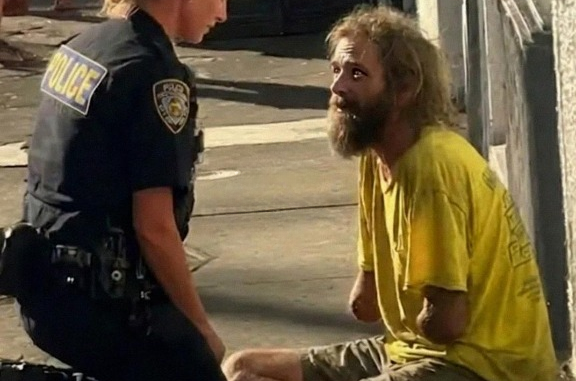
I stopped the cruiser and pushed through the bystanders. A few people were filming. A couple looked disgusted. A teenager smirked. A woman pulled her son away like the man on the ground was contagious.
He was slumped against a wall, face scraped raw, shirt clinging to his ribs. His breathing was faint. And his arms—gone below the elbows. Sleeves neatly pinned as if this was simply who he was.
“Someone call 911,” I snapped as I knelt beside him. “Sir, I’m a police officer. You’re not alone.” His pulse was weak. His eyelids flickered.
I began CPR. My knees dug into gravel. Sweat burned down my back. Sirens grew louder. EMTs took over, thanked me, and loaded him into the ambulance. The crowd drifted off, already forgetting him.
That night I moved through the routine—kids’ homework, nightmares, hair braiding—but my mind kept replaying Leo on that sidewalk… this man against the wall… two people everyone left behind.
The next morning, a sharp honk pulled me to the window. A red Mercedes sat in my driveway. The driver stepped out—the same man from the alley. Same face. Same scar. No arms.
“I’m sorry to intrude,” he said. “My name is Colin. You saved my life.” He asked to talk.
We sat on the porch. He explained how a car mirror clipped him, how he fell and couldn’t get up, how everyone ignored him. He’d passed out and woken to see me.
Then he told me about losing his wife—how she had a seizure in public and people filmed her instead of helping. By the time EMTs reached her, she was gone. Afterward, he spiraled, worked himself to exhaustion, and one night lost both arms in a factory accident.
“I stopped expecting kindness,” he said. “Until you.”
He’d gone to the station to find me. My captain had told him about Leo, and that I knew too well what it meant for no one to stop.
After that day, Colin started visiting. At first, the kids weren’t sure what to think. But slowly—Aria’s blunt questions, Adam’s curiosity, Alex’s cautious distance—they warmed to him. By the second visit, Colin was watching cartoons with the younger two while Alex quietly set the table for him.
One evening, under the stars, I asked, “Does it bother you when people stare?”
“Sometimes,” he said with a laugh. “Mostly I feel bad for them. They’re missing the best parts of the story. Although ice cream cones? Impossible.”
For the first time in months, I laughed—really laughed.
Colin never tried to take Leo’s place. He didn’t force himself into our lives; he simply showed up when it mattered. He was steady. Kind. Present.
One night, he nudged his arm stump against my hand—gentle, hesitant. I turned my palm up, and he rested it there. It felt unexpectedly natural.
“I never thought I’d have something worth living for again,” he whispered.
“You gave it back to us too,” I told him.
He swallowed. “Would you let me try to make you happy, Elena?”
I thought of Leo, of people walking around him as he died, of the crowd that avoided Colin. I thought of the alley, the kids’ laughter from the living room, the red Mercedes waiting outside.
“Yes,” I said. “I would.”
People once walked past my husband. They walked past Colin. But that day, I didn’t. And in saving him, I discovered life wasn’t finished saving me either.