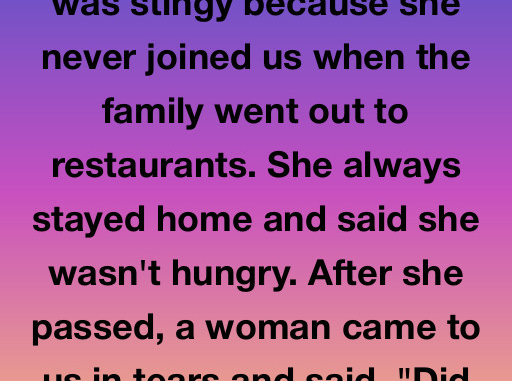
I used to think my grandmother was simply frugal — the kind of woman who’d rather stay home in worn slippers than join us for dinner. She’d smile, tell us she wasn’t hungry, and settle into her old cardigan. I assumed she just preferred quiet to the noise of family life.
I was wrong.
After she died, strangers began showing up at our door, each carrying a story about the woman we thought we knew. Janine was the first — a mother from three blocks away who tearfully told us Grandma had been buying groceries for her kids every month for years. Then came a man in a wheelchair she visited weekly, a teen she helped apply to college, a clerk she encouraged with small acts of kindness. One by one, they revealed the life she’d lived in secret.
Going through her things, we found notebooks filled with simple entries: “Paid electric bill for J.” “Brought soup.” “Lonely man waved today.” She prayed for strangers the same way she prayed for us. Even her shabby shoes made sense — she chose to walk her kindness into other people’s lives.
We followed her footsteps around town: her favorite chair at the nursing home, the library kids she read to, the grocery store that swore she made the place gentler. In the attic, a tin labeled “Rainy Day Fund” held $872 and a note: “For whoever needs it most.” We gave it to Janine’s son so he could start community college.
Inspired, I began doing small acts of help myself — nothing big, just the quiet sort of generosity she mastered. And when I lost my job and felt too proud to admit it, a young woman approached me in a café. Grandma had once read to her at the library. She handed me a sealed envelope and said, “Kindness is a seed. She told me to give this when it mattered.” Inside was a check for a thousand dollars. It carried me through until I found work again.
Now I understand what kind of legacy Grandma left behind — not one built with applause or attention, but with worn shoes and deliberate kindness. Some people save the world loudly. Others do it gently, one small act at a time.
You don’t need money or a platform to be generous. Just eyes that notice and a heart willing to act. Buy the sandwich. Pay the fare. Leave the note. To you, it may feel small. To someone else, it might be everything.
My grandmother wasn’t frugal — she was rich in all the ways that matter. And I try to walk in her shoes, the ones that “have more to walk,” carrying her quiet generosity forward