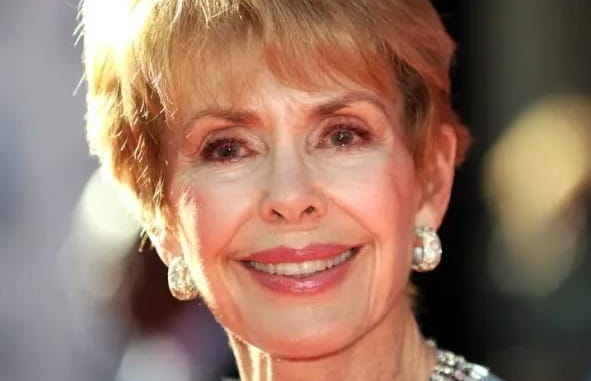
The death of Barbara Rush signals the closing of a remarkable chapter in American film history, marking the loss of one of the final enduring figures from Hollywood’s Golden Age. A Golden Globe winner and a familiar presence alongside cinema’s most celebrated leading men, Rush embodied a style of stardom that now feels almost mythic—an era defined by grand studios, glowing marquees, and performers whose presence commanded attention before they ever spoke. News of her passing at 97 prompted a wave of reflection and nostalgia, recalling a time when movies occupied the very heart of popular culture.
Rush’s career stood as a testament to range, discipline, and quiet brilliance. Rising to prominence in the 1950s, she earned early recognition as the Golden Globes’ “Most Promising Newcomer,” a distinction she spent decades justifying through consistent, memorable work. She moved confidently among Hollywood giants, sharing the screen with Marlon Brando in The Young Lions, matching the refined charm of Dean Martin, and holding her own opposite Frank Sinatra. Rather than being eclipsed by such formidable co-stars, Rush brought a calm strength and understated magnetism that elevated every scene she entered.
Her performances spanned genres with ease. From science fiction classics like It Came from Outer Space—a role that earned critical praise—to the emotionally layered melodramas of Douglas Sirk, including Magnificent Obsession, Rush demonstrated technical precision without ever calling attention to it. She adapted effortlessly to the demands of the studio system, proving equally compelling in spectacle-driven films and intimate character dramas. Though she is often remembered for the elegance of 1950s Hollywood glamour, her talent extended far beyond style or era.
Yet her legacy cannot be measured by film credits alone. To her family—especially her daughter, journalist Claudia Cowan—Barbara Rush was known not as a screen icon, but as a steady and grounding presence. In an industry famous for instability, she offered consistency, warmth, and wisdom. She placed family life above fame, showing that it was possible to live in the spotlight without sacrificing authenticity or compassion. Her most meaningful success, those closest to her say, was not professional acclaim but the loving, secure world she created at home.
There is a quiet poetry in the timing of her passing. She died on a holiday she cherished, her life drawing to a close with the same grace that defined her career. Even in her late nineties, she was described as spirited and curious, her energy undimmed by time. Her death came without spectacle or turmoil, reflecting a life marked by dignity rather than excess.
Barbara Rush’s legacy lives on in many forms: in the films that continue to be watched and studied, in the promise of early recognition that she fully honored, and in the personal stories cherished by her family. She served as a bridge between classic Hollywood and the modern era, reminding audiences of a time when craftsmanship, mystery, and professionalism defined stardom.
Her passing also underscores a broader truth—the fading of a particular kind of celebrity. Performers of her generation carried an air of elegance and restraint that feels increasingly rare in an age of constant visibility. Watching a Barbara Rush film today is not only an artistic experience but a journey into a period when cinema felt ceremonial and stars felt larger than life. Yet the warmth she projected was genuine, rooted in a sincere love for her craft and for people.
As Hollywood reflects on her long life and career, admiration centers not only on her longevity but on how she lived her final years—with integrity, humility, and grace. She witnessed enormous changes in the world and in entertainment, yet remained grounded in her values. Her life stands as proof that success and privacy need not be mutually exclusive.
Though the curtain has fallen, the glow Barbara Rush brought to the screen endures. Revisiting her work reveals more than a gifted actress—it reveals a woman who exemplified the finest qualities of her profession. The world is dimmer without her, but richer for all she gave. Her legacy rests not in spectacle, but in the lasting beauty of a life lived with purpose, kindness, and quiet excellence.