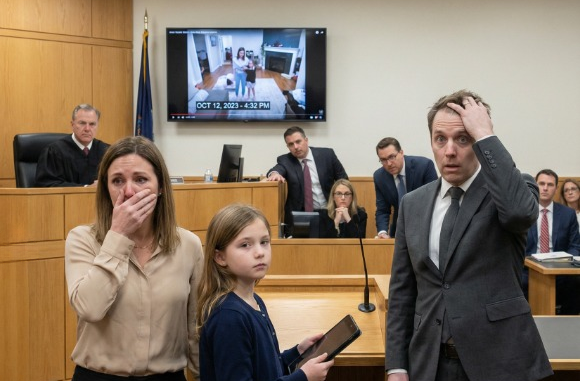
…there he was, standing in our kitchen at 2:13 a.m., the time stamp glowing in the corner of the screen.
He wasn’t calm.
He wasn’t controlled.
He was yelling.
Not at me.
At Harper.
The sound wavered for a second, then his voice filled the courtroom—harsh, angry, impossible to mistake.
“Stop crying,” he barked. “Do you have any idea how much stress you cause? If you tell your mother, you’ll destroy everything. Is that what you want?”
The room seemed to gasp all at once.
Then Harper’s voice—small, trembling.
“I just wanted Mommy…”
A sharp crash followed. Glass hitting the counter. Breaking.
My chest tightened. I could barely breathe.
The clip went on briefly—mercifully brief. Caleb pacing, fists clenched, his face twisted into a version of him I knew too well, one that only appeared behind closed doors. His voice returned, colder now.
“You don’t say anything. This stays between us. I’m the only one holding this family together.”
The screen went dark.
Silence swallowed the courtroom.
Caleb stared straight ahead, color drained from his face. His attorney slowly lowered herself into her chair, as if reality had finally caught up with her.
The judge didn’t look at me.
He didn’t look at Caleb.
He looked at Harper.
“Is that why you recorded it?” he asked softly.
She nodded. “I thought if I forgot it, maybe it wouldn’t be real. But I couldn’t forget.”
The judge closed his eyes for a moment. When he opened them, something had changed.
“Ms. Dawson,” he asked me, “were you aware of this recording?”
I shook my head, tears falling freely. “No, Your Honor.”
He nodded, then turned to Caleb.
“You described your wife as unstable,” the judge said evenly. “You described yourself as the steady one. This video tells a very different story.”
Caleb tried to speak.
“No,” the judge interrupted quietly. “You’ve spoken enough.”
The decision didn’t come that day—but the truth did.
Weeks later, I was granted primary custody. Caleb was limited to supervised visits, contingent on therapy, parenting classes, and a full psychological evaluation.
As we stepped outside the courthouse, Harper slipped her hand into mine.
“I’m sorry I didn’t tell you sooner,” she whispered.
I knelt in front of her on those stone steps. “You did what you could to protect yourself,” I said. “That took courage.”
She looked at me. “I was scared.”
“I know,” I said. “And you spoke anyway.”
That was when I truly understood:
Kids don’t need flawless parents.
They need safe ones.
And sometimes the quietest voice
carries the clearest truth.
Harper didn’t just change the outcome.
She changed everything.