Long before royal titles, front-page headlines, and constant media attention, Meghan Markle was simply a child growing up in Los Angeles, trying to find her place in a world that left little room for complexity. Her life did not begin behind palace walls or within privilege. It began with frozen meals, quiet hours spent alone after school, and an unspoken question familiar to many young people: Where do I fit in?
Raised by a Black mother and a white father, Meghan became aware early on of how quickly society assigns labels. She has often spoken about the confusion of being biracial in environments that demanded simple definitions. Strangers frequently misidentified her family dynamics, assuming her mother, Doria Ragland, was a caregiver rather than her parent. These repeated moments—subtle yet persistent—shaped Meghan’s understanding of identity, prejudice, and visibility long before she had the words to articulate them.
Her upbringing was grounded and practical rather than glamorous. Meghan described herself as a latchkey kid, coming home to an empty house while both parents worked long hours. Her father, Thomas Markle Sr., built a career in television, while her mother worked as a makeup artist and yoga instructor. Meals were often eaten in front of the TV, with Jeopardy! playing in the background. These routines weren’t signs of lack, but early lessons in self-reliance and appreciation.
There are differing accounts of those early years. Her father has publicly challenged parts of Meghan’s narrative, particularly claims of financial struggle, emphasizing that he provided stability and care. Yet memories are deeply personal. For Meghan, what endured was not material comfort or its absence, but the emotional weight of feeling different, overlooked, and uncertain of belonging.
After her parents divorced, Meghan moved between two distinct worlds. She lived primarily with her father from the age of nine, while remaining close to her mother, who relocated to a predominantly Black neighborhood and found support within a strong community of women. Doria later described that circle as instrumental in helping raise her daughter. Their bond was honest and unconventional. Doria once recalled asking Meghan if she felt like her mother—only for Meghan to reply that she felt more like an older, bossy sister. That candor became the foundation of their relationship.
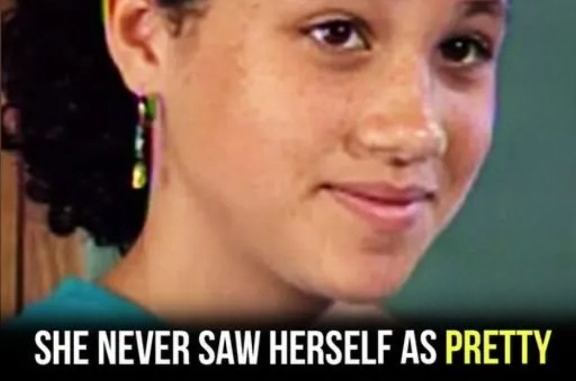
Teenage years intensified Meghan’s self-doubt. She has openly said she didn’t see herself as “the pretty one,” instead identifying as the smart, driven overachiever. Intelligence became her shield. At just eleven, she wrote a letter challenging a sexist television commercial—and succeeded in getting it changed. Even then, she understood the power of speaking up.
With limited means, Meghan learned to savor modest pleasures. Dinner at Sizzler’s salad bar felt special. Girl Scout trips were shaped by affordability, and gratitude was woven into everyday life. When her father later received a significant lottery payout, it enabled access to elite education and training, accelerating a journey Meghan was already determined to pursue.
Her work ethic appeared early. By thirteen, she was juggling multiple jobs—babysitting, working at a donut shop—while imagining a future far bigger than her surroundings. Acting entered her life on the set of Married… with Children, where her father worked. Though she later joked about being a Catholic schoolgirl surrounded by adult sitcom humor, the experience introduced her to storytelling and performance in a way that felt instinctive.
Still, Hollywood struggled to place her. As a biracial actress, Meghan was frequently described as “ethnically ambiguous.” She has said she was often considered not Black enough for some roles, not white enough for others. That sense of existing in between—so familiar from childhood—followed her into adulthood, shaping both frustration and resilience.
Eventually, persistence brought opportunity. In her early thirties, Meghan reflected publicly on happiness, personal growth, and self-compassion. Around that time, her career took a decisive turn with her role as Rachel Zane on Suits. The series brought recognition, financial stability, and confidence—but it was not the culmination of her story.
Everything shifted in 2016, when she met Prince Harry. Their relationship unfolded quickly and under relentless public scrutiny. In 2018, they married at Windsor Castle before a global audience. The marriage represented transformation within the monarchy—but it also unleashed an unprecedented level of media pressure.
Motherhood brought profound joy alongside real danger. Meghan and Harry welcomed their son, Archie, followed by their daughter, Lilibet. Privately, Meghan faced a life-threatening postpartum medical emergency. In 2025, she revealed on her podcast Confessions of a Female Founder that she had suffered from postpartum preeclampsia, a rare and serious condition. She spoke calmly and directly—about caring for her children while navigating a crisis that could have taken her life.
Survival was later followed by grief. Meghan also shared that she experienced a miscarriage, describing the loss with raw honesty. These experiences shattered any lingering illusion of a fairy tale. What remained was endurance.
Today, Meghan Markle occupies a position few ever will—globally visible, intensely scrutinized, influential, and unmistakably human. Her evolution from an insecure teenager to an international public figure is not a neat arc of success, but a layered story shaped by race, opportunity, determination, love, and loss. She no longer seeks validation from institutions that once tried to define her. She speaks in her own voice, builds on her own terms, and raises her children with the perspective of someone who has lived many chapters in one lifetime.
This is not a story about royalty.
It is a story about self-determination.
And it is still unfolding.