There was no note. No explanation. No goodbye.
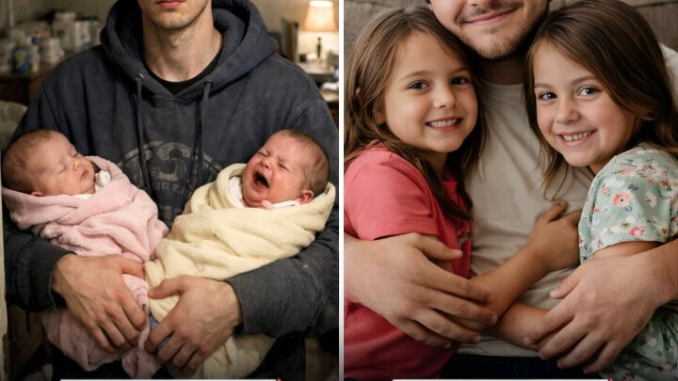
One night, she was there—tired, distracted, but present. By morning, she was gone. I woke to the sound of two newborns crying in our tiny apartment, the air heavy with formula and panic. Her phone was disconnected. Her closet empty. Even her toothbrush was gone.
I froze in the doorway, still wearing a hoodie from my senior year. College brochures lay scattered on my desk, untouched. I thought it must be a mistake. That she’d come back before the day ended.
She never did.
That day divided my life into before and after.
I had dreamed of becoming a surgeon—years of advanced classes, volunteering, and entrance exams had prepared me for it. I pictured myself in a white coat, steady hands, saving lives.
Instead, I learned to heat bottles at three a.m., hands trembling.
I learned to swaddle one baby while the other screamed until her face turned red.
I learned to recognize cries even before fully waking.
I learned how quickly diapers vanish, how expensive formula is, how terrifying silence can be with infants.
I took every job I could—overnight warehouse shifts that left my arms sore, delivery runs where I prayed the girls would still be asleep when I returned, odd cash work. Sleep came in tiny fragments.
People told me to call social services, to let the system handle it, to think of my future.
But I couldn’t imagine my sisters growing up in strangers’ homes, calling someone else Mom and Dad, wondering why their own family abandoned them.
I fought. Every day. For seven years.
I learned to make cheap meals stretch, to turn hand-me-downs into treasures, to throw birthday parties with homemade cakes and dollar-store candles that still felt magical.
The girls became my entire world.
Before they could even say my name, they called me “Bubba.” I wore that name with pride.
They fell asleep on my chest, tiny hands gripping my shirt, and I whispered promises into the dark: I’m here. I’m not going anywhere. You will never feel abandoned.
Sometimes, when the apartment was quiet, I let myself grieve—not just for the life I’d given up, but for the mother I thought I had. I tried not to hate her. I told myself there must be a reason.
Seven years passed with no word. No calls. No cards. No remembered birthdays.
Then, one afternoon, just as life had settled into a fragile routine, there was a knock at the door.
It wasn’t casual. It wasn’t rushed. It was deliberate.
I opened it and my stomach sank.
She stood there, a stranger wearing my mother’s face. Her hair perfect, her coat expensive, jewelry catching the light. She looked rich. And she looked at me as if I didn’t exist.
Then she saw the twins. Her expression shifted instantly.
“Oh,” she said softly, smiling. “There they are.” She held designer bags full of toys, clothes, and gifts the girls had never dreamed of.
“Girls,” she said, stepping closer. “It’s me. Your mom.”
For a moment, my chest tightened. Maybe she had come to make amends. Maybe she regretted leaving. Maybe she wanted to know them.
Then she spoke again.
“I’ve done very well for myself,” she said, admiring her manicure. “And I think it’s time I took them. They deserve more than this.”
Her eyes swept the apartment, assessing. She wasn’t here to reconnect. She was here to take.
She rattled off plans: private schools, travel, a life of comfort. She said the girls shouldn’t struggle because I had “chosen” to be their guardian—as if loyalty was a mistake.
Then came the final blow:
“I’ve already spoken to a lawyer,” she said calmly. “I’m their biological mother. You don’t stand a chance.”
Something inside me broke, but I didn’t yell or curse. I knelt in front of my sisters.
“Go to your room,” I said gently. They hesitated but obeyed.
When the door closed, I stood taller than ever.
“You left,” I said quietly. “You abandoned them. You abandoned me.”
She shrugged. “I did what I had to do.”
“No,” I said. “You did what was easiest.”
I reached for a folder I had kept hidden for years: every receipt, school record, doctor visit, and legal document proving my guardianship.
“You don’t get to erase seven years with gift bags,” I said. “They don’t need your money. They need love, stability, someone who stayed.”
Her smile finally faltered.
Weeks later, after lawyers, courtrooms, and countless explanations to two frightened little girls, the judge ruled in our favor. She lost all rights.
When she left the courthouse without looking back, a weight lifted from my chest.
That night, I tucked my sisters into bed.
“Are you leaving?” one asked quietly.
“No,” I said, voice thick. “Never.”
They wrapped their arms around me. And in that moment, I realized something profound: I may not have become a surgeon, but I saved two lives. And that will always be enough.