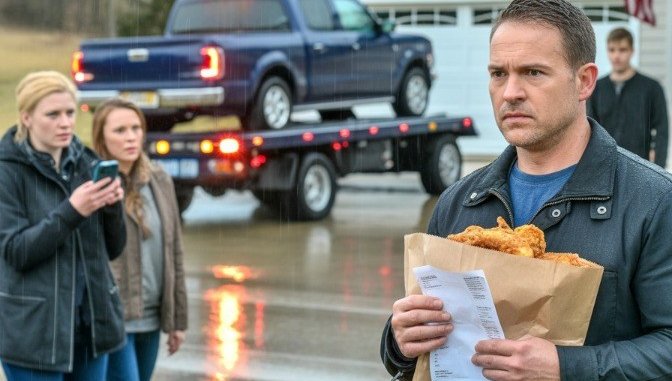
That night, the cold in Hendersonville sliced straight through the garage, seeping in under the door and into my bones. I stood there with a paper bag of fried chicken from Ingles warming my hands, thinking about nothing more than sitting down to a normal dinner. Just another quiet evening. Then I heard my stepson speak—and the world I thought I lived in collapsed instantly.
“Yeah, I already cut the brake line,” Trevor said, his tone casual, almost bored. “See you at his funeral tomorrow.”
A dull blue light spilled from the partially open side door. He was on his phone, leaning comfortably, completely unfazed by the words he’d just spoken. My stomach dropped so hard it felt like the floor vanished beneath me.
Then Deborah’s voice came through the speaker.
Calm. Controlled. Terrifying.
“Tomorrow?” she asked, not in alarm, but with relief. “Just be careful.”
That was the moment I understood a truth no one is ever ready to face: the woman I’d been married to for eleven years was quietly discussing my death with her thirty-two-year-old son.
I didn’t rush in. I didn’t yell. I didn’t demand answers. Years working as an HVAC technician had drilled one rule into me—never act in a panic. Panic causes mistakes. That rule saved my life.
I backed away unnoticed and sat in my car at the curb, hands trembling against the steering wheel, breath fogging the windshield. In a town this small, I knew exactly what would happen if I went to the police without proof. Deborah would cry. Trevor would play the concerned son. I’d be painted as the unstable husband unraveling. Fear wasn’t enough—I needed evidence.
I ordered a tow truck through a roadside assistance app and watched as my silver F-150 was loaded onto a flatbed and pulled away under the darkness. I told the driver it was a mechanical issue. As the taillights faded, I felt my old life split cleanly in two.
I drove thirty winding minutes into Asheville, straight to the one person who would believe me without hesitation—Eugene Carter, Trevor’s biological father.
Eugene was a retired mechanic who knew engines—and knew his son. He slid beneath the truck with a flashlight. When he emerged, his face had drained of color.
“This wasn’t accidental,” he said quietly. “The brake line was sliced. Clean. Deliberate.”
Seeing the damage with my own eyes turned suspicion into certainty. This wasn’t paranoia. It was attempted murder.
With help from my attorney, Elizabeth Garrett, I began recording everything. Courts don’t run on emotion—they run on facts. While Deborah flooded social media with posts about her “unstable husband” who had “walked out,” I stayed silent and collected proof.
A friend helped obtain security footage from a nearby AutoZone. The video showed Trevor purchasing a tubing cutter. Minutes later, Deborah appeared, paying cash for supplies—no receipt, no paper trail.
The most disturbing discovery came from my own house.
During a supervised visit to retrieve personal items, I found a prepaid burner phone hidden inside a nightstand drawer. It contained hundreds of messages between Deborah and an insurance agent named Glenn Hartman. She spoke openly about a future together—funded by my retirement savings and a life insurance policy that would pay out after my “accidental” death.
But the final piece was the one that shattered me.
Months earlier, after a rash of thefts in the neighborhood, I’d installed motion-activated cameras in the garage. With shaking hands, I reviewed the footage from that night.
It was unmistakable.
Trevor entered the garage. Deborah followed.
“You sure about this, Mom?” he asked.
Her response froze my blood: “Just do it. Make it clean. No fraying. It has to look like wear and tear.”
I watched my wife stand there while her son prepared to kill me.
At the preliminary hearing, Deborah arrived dressed for sympathy—navy blazer, silver cross, tissues ready. But truth doesn’t care about appearances. The prosecution played the garage footage on a large screen. Her voice echoed through the courtroom. Gasps followed. Even the bailiffs looked away.
When Glenn Hartman testified about the insurance arrangement, Deborah panicked and turned on her own son. “I didn’t think he’d actually go through with it!” she screamed.
Trevor fired back, shouting that she had planned everything.
The judge ignored the chaos. Both were taken into custody without bail.
Trevor accepted a plea deal—eighteen to twenty-five years. Deborah went to trial and was convicted on all charges, receiving fifteen to twenty years for conspiracy to commit murder.
Today, I live in a small apartment in Asheville overlooking the French Broad River. I’m fifty-nine now. The scars of betrayal remain, but the fear is gone. I’ve begun seeing a woman named Margaret—a librarian who understands that trust is rebuilt slowly, step by careful step. We walk along the river in the evenings, and for the first time in years, the air feels safe.
I didn’t survive because I was stronger or smarter.
I survived because I listened to the quiet warning that something was wrong—and because I chose patience over panic.
Some battles aren’t won by confrontation. They’re won with restraint, evidence, and the courage to walk away from a game that was rigged against you.
The river keeps moving forward.
And now—so do I.