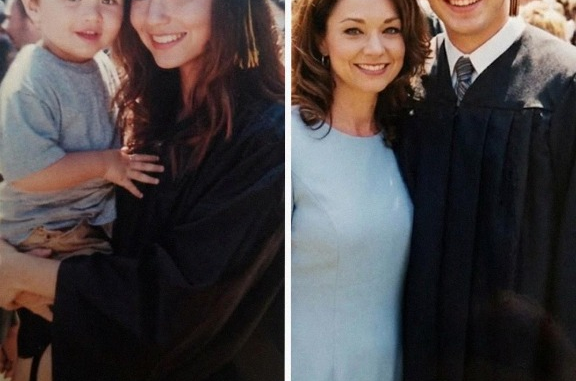
For twenty-two years, my life rested on one unshakable truth: it was just my mom and me. Laura and Evan against the world. My mother raised me alone with a quiet strength that felt almost legendary. She fixed broken sinks in whatever small apartment we lived in, taught me to drive, and never missed a night of reading me to sleep. Her version of the past never wavered. She told me she became pregnant at twenty while in college, and that my father vanished the moment he found out. “He wasn’t ready,” she’d say simply, and that was the end of the story. I never questioned it. I grew up believing I was the result of abandonment—and that belief only deepened my admiration for the woman who chose to stay.
My college graduation was meant to be the final chapter of our shared struggle. It was a bright but chilly spring day in Chicago, sunlight bouncing off glass buildings while the air still stung with cold. I spotted my mom instantly in the crowd, glowing in a pale blue dress and the pearl necklace she wore only on life’s biggest days. When my name was called and I crossed the stage, she stood and applauded like no one else in the stadium mattered.
After the ceremony, surrounded by graduates and families celebrating with hugs and champagne, I noticed a man watching me from near a stone bench. He looked to be in his mid-forties, sharply dressed, and his stare carried a strange intensity—as if he were searching for something familiar in my face. When he approached, my mother’s grip on my arm tightened, her body stiffening as color drained from her face.
“Evan?” he asked. I nodded, unsure. He glanced at my mother, whose expression was a mix of panic and anger. “I’m sorry to interrupt,” he said quietly. “But I need to speak with you. I’m your biological father.”
I laughed nervously, convinced this had to be some bizarre mistake. But the man—Mark—was serious. He told me the story I’d known my entire life wasn’t true. Not a cruel lie, he insisted, but a devastating one. For twenty-two years, he believed I had never been born. “She told me the pregnancy ended,” he said, looking at my mother. “I thought there was no child.”
The celebration vanished instantly. We moved away from the crowd to a quiet stretch of grass near the parking lot. There, my life’s foundation was pulled apart and rebuilt piece by piece. Mark explained that he and my mother had been together in college, and while they were young, he never intended to leave. But his parents—wealthy, influential, and fiercely controlling—had intervened. Without his knowledge, they pressured my mother, threatened legal battles, and tried to pay her off to protect their son’s future.
My mother finally spoke, her voice barely steady. “I never took a cent,” she said through tears. “But I was twenty and alone. They made it sound like they could take you away the moment you were born. I was terrified. So I told Mark the baby was gone and disappeared. I thought it was the only way to keep you safe.”
Mark didn’t stay long. He handed me his business card, hands shaking, and told me there was no obligation to contact him. He’d only learned the truth six months earlier from a mutual acquaintance. Then he walked away, leaving me standing in the ruins of everything I thought I knew.
That night, our apartment felt unbearably quiet. My cap and gown lay tossed over a chair—relics of a day that no longer felt celebratory. We sat at the kitchen table with untouched cups of tea. My mother looked smaller somehow, the weight of a secret she’d carried for two decades finally visible in her face.
“I should have told you,” she said softly. “But every year made it harder. The truth started to feel like a weapon. I wasn’t trying to be noble—I was just a scared girl who wanted to keep her son.”
I realized then that I had always seen her as unbreakable, forgetting that even the strongest structures endure immense strain. She hadn’t been alone because no one wanted her—she chose solitude to protect the life she was building for me. I reached for her hand. “You didn’t leave anyone,” I said. “You chose me. That’s all that matters.”
Reconnecting with Mark wasn’t dramatic or easy. It was slow and awkward, marked by cautious conversations and long pauses. I kept his card in my wallet for weeks before sending a message. Eventually, we began meeting for coffee once a month, learning how to exist in each other’s presence. He spoke of his regrets and his life but never blamed my mother. He understood the fear she had been forced to live with.
With time, my anger softened into something quieter and more complex. I came to see that the absence in my childhood wasn’t caused by a lack of love, but by fear and impossible choices. My mother found her peace too. Months later, while watching a movie together, she noticed Mark’s name appear on my phone and smiled. “I’m glad you’re talking,” she said. “Whatever you decide, I trust you.”
I didn’t suddenly gain a father in the traditional sense. You can’t replace twenty-two years of absence with a handful of conversations. But I gained the truth—and through it, a deeper understanding of my mother. She wasn’t a woman abandoned by a man who ran. She was a guardian who stayed, no matter the cost. My story didn’t unravel on graduation day. It was finally finished.