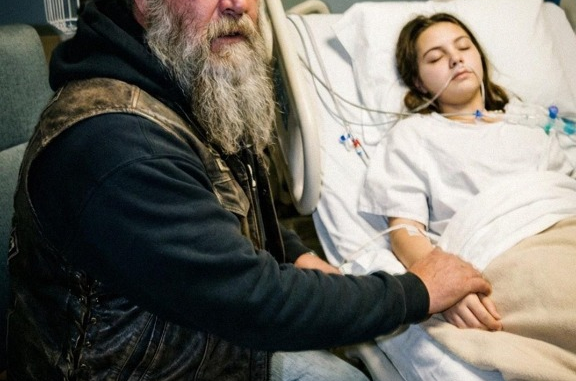
For six months, a biker came to my daughter Hannah’s hospital room every day at 3 p.m., quietly holding her hand, reading to her, and leaving without a word to me. I didn’t know who he was—until one day I followed him into the hallway.
His name was Mike—and he was the drunk driver who’d put my seventeen-year-old daughter in a coma. He hadn’t defended himself or asked for forgiveness; he came every day to sit with the consequence of his actions, at the exact time of the crash, silently facing what he’d done.
At first, I told him to stay away. But the days felt emptier without him. Slowly, he became part of Hannah’s recovery, reading to her, sitting quietly, letting her set the pace. Weeks later, Hannah squeezed my hand—a small sign of life. Soon after, she opened her eyes.
When she was stronger, we told her the truth. “I don’t forgive you,” she said, and he accepted that. But she added, “Don’t disappear.”
Months of therapy followed. Mike never pushed; he just showed up. Nearly a year later, Hannah walked out of the hospital, taking both my arm and his.
“You ruined my life,” she told him.
“I know,” he replied.
“And you helped me keep living it,” she added.
Now, every year on the anniversary of the crash, we meet for coffee at 3 p.m.—not to forgive, not to forget, but to keep living honestly with what happened.