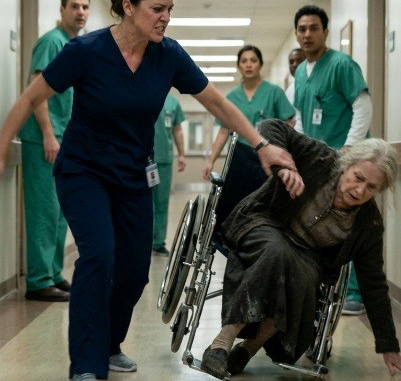
The lobby of St. Jude’s Memorial didn’t feel like a place meant for healing. The air burned with industrial cleaner and that sterile, metallic scent that comes from rigid rules and unchecked authority. This was a building where human value was measured in insurance policies—and at that moment, my mother, Clara Miller, was being judged as having none.
At seventy, she looked impossibly small beneath the buzzing fluorescent lights, clutching her faded lavender cardigan as though it might protect her.
“I’m sorry,” she whispered to the woman towering above her. “My son said the transfer should already be completed. There must be a delay.”
Brenda Vance, Head of Surgery, didn’t see a patient. She saw an inconvenience. Something that didn’t belong on her polished floors. Her scrubs were sharply pressed, her posture rigid, her expression dripping with disdain.
“The son story again, Clara?” Brenda announced loudly, making sure the entire waiting area heard her. “You’re fifteen thousand dollars behind. This is a private hospital, not a shelter. That ‘successful’ son of yours is probably flipping burgers somewhere and avoiding your bills.”
A young intern hesitated, clearly uncomfortable, but Brenda silenced her with a single glare. Then she grabbed the handles of my mother’s wheelchair and jerked it toward the doors.
“I’m escorting you outside,” she snapped. “You can wait at the bus stop for your imaginary millionaire.”
“Please,” my mother pleaded. “I need my oxygen.”
“Then you should’ve paid for it,” Brenda shot back.
In the struggle, my mother’s purse slid from her lap. Pepper candies, tissues, and a worn photograph of me scattered across the floor. When Clara tried to steady herself, Brenda snapped completely.
It wasn’t a push.
It was a slap.
The sound cracked through the lobby, sharp and final. My mother’s glasses skidded across the tile. Silence swallowed the room. Brenda stood over her, breathing hard, threatening to have security charge my mother with assault if she didn’t stay quiet.
That was when the glass doors slid open with a hiss that sounded like authority entering the room.
I stepped inside, flanked by two men in tailored suits. The space froze. I took in everything instantly—the spilled purse, the broken glasses, the red mark blooming on my mother’s cheek.
Brenda, sensing wealth but not yet danger, turned toward me with a practiced smile.
“Sir, I apologize for the disturbance. We’re dealing with a non-compliant patient.”
I didn’t acknowledge her.
I knelt on the cold tile, took my mother’s shaking hands, and said softly, “I’m here, Mom. I’m sorry I was late.”
“Leo,” she whispered, tears falling. “She said you weren’t coming.”
I kissed her forehead and stood. At six-foot-two, I suddenly felt larger than the room itself. I faced Brenda.
“You told her she didn’t belong here. You told her I wasn’t coming because her clothes looked old?”
Brenda laughed nervously. “Well, Mr. Miller, if you’re able to pay—”
“Pay?” I cut in, nodding to my assistant, who opened a leather folder. “Ten minutes ago, Miller Capital finalized its acquisition of St. Jude’s Healthcare Group. As of this morning, this hospital—and everything inside it—belongs to me.”
Color drained from her face as she stammered about executives and contracts. I stopped her with a raised hand and signaled security.
“I didn’t just fire you,” I said quietly, leaning in. “This afternoon, I’m buying your mortgage. Tomorrow, I’m filing an abuse report with the State Nursing Board. By the time I’m finished, you won’t qualify to mop the floors you tried to throw my mother onto.”
As she collapsed, I wheeled my mother toward the elevators. But this wasn’t just about Brenda. It was about a system that had turned compassion into currency.
I moved Clara into the Presidential Suite on the tenth floor—soft lighting, white oak floors, air scented with lavender. I assigned Maya, the intern who’d tried to intervene, as her primary nurse. When my mother finally slept, I headed for administration.
Fear rippled through the staff as I passed.
I entered CEO Thomas Sterling’s office as he frantically packed a briefcase. He started blaming a “rogue employee.” I slammed my hand on the desk.
“I own this desk, Thomas. And I’m ordering a full forensic audit of every dollar that passed through your office.”
“It was business,” he whispered. “We prioritized premium insurance.”
“Business?” I repeated. “You turned a hospital into a hunting ground. Leave the briefcase—it’s evidence. And if I see you here again, I’ll take it personally.”
After he fled, Dr. Thorne—head of internal medicine—approached me.
“Are you here for revenge,” he asked, “or reform?”
“Both,” I answered. “Start by explaining why research funding was cut to fund executive bonuses.”
By midnight, a storm raged outside the boardroom as fiercely as the one inside. I sat at the head of the obsidian table, facing executives who treated patients like balance sheets. Arthur Vance—Brenda’s protector—was among them.
“You can’t dissolve the board,” he protested.
“I’m the majority shareholder,” I replied calmly. “And I’m looking at four million dollars funneled into your shell company. Was it coincidence when Brenda received a bonus the same week a discharged patient lost his leg?”
I didn’t wait for answers. Resignations were signed. Authorities were waiting.
At dawn, I returned to my mother’s room. The hospital felt different—not silent with fear, but attentive. I sat beside her as she slept. The bruise on her cheek wasn’t an ending.
It was a beginning.
I’d spent my life being ruthless in finance. Now, I would use that power differently.
At St. Jude’s, dignity would be the only currency that mattered.