Six years is a long stretch of time to act as though someone has vanished from your life.
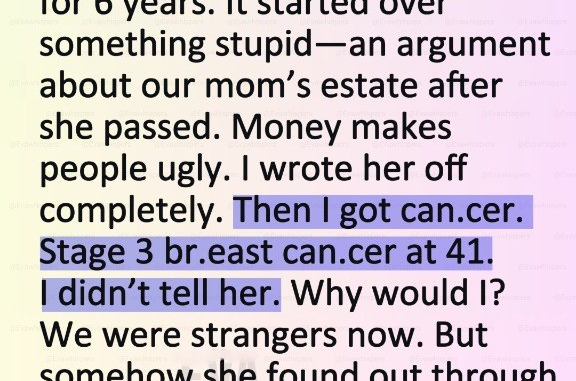
My sister and I managed it. Silence became our unspoken agreement. It took root after our mother died, when grief collided with legal documents and long-buried resentments. What began as disagreements over her estate slowly unraveled into something deeper—old childhood comparisons, unspoken rivalries, and questions of who had given more and who had been loved more. The inheritance didn’t cause the fracture, but it sharpened every existing wound.
We said things meant to leave scars. I remember the moment everything ended, though the exact words have blurred. What stayed with me was the sensation of something closing inside me, like a locked door. I decided then that I was finished. I told people I didn’t have a sister. I edited her out of my life as if she’d been a mistake.
Time moved on—or at least it pretended to.
Then, at forty-one, the illusion collapsed.
A diagnosis of stage three breast cancer rearranges your world without warning. The doctor spoke gently, clinically. I nodded as if I could process it all. Inside, fear roared. I sat alone in my car afterward, hands on the steering wheel, wondering how something so catastrophic could leave the world looking so unchanged.
I told friends. I informed my workplace.
I did not tell my sister.
Six years had turned us into strangers. I convinced myself she didn’t need to know. I convinced myself I didn’t need her.
Chemotherapy began in the winter. The hospital smelled of disinfectant and burnt coffee. My first treatment dragged on for hours, leaving me heavy with exhaustion and nausea.
When I finally stirred, I expected to see a friend or neighbor who had offered to help.
Instead, through the fog, I saw her.
My sister.
She sat hunched forward in a waiting chair, hair pulled back the same way she wore it as a child when we were late for school. Her eyes were red and swollen. She looked hollowed out in a way that spoke of more than lost sleep.
“I drove,” she said simply. “Eleven hours.”
Later, I learned she hadn’t rested at all. A cousin had mentioned my diagnosis offhandedly. She hadn’t called or sent a message.
She just got in her car and drove through the night.
She didn’t apologize.
Neither did I.
She took my hand carefully, as though I were fragile, and said, “I’m here.”
That was all. No explanations. No revisiting the past. Just presence.
And then she stayed.
She came to every appointment. Every scan. Every harshly lit room where time stretched and hope wavered. When my hair began falling out, she arrived with clippers and shaved her own head that same evening—no discussion, no hesitation.
When the nausea became unbearable, she learned exactly how to help without making it worse. At three in the morning, when I was trembling and crying and apologizing for what my body was doing, she sat on the bathroom floor and hummed the songs our mother used to play while cooking.
She moved into my guest room for nearly half a year. She brought her own pillow. Quietly handled the laundry. Knew my medication schedule better than I did.
We never reopened the argument.
The inheritance. The money. The years lost to anger and grief. Maybe we were both afraid that digging into it would break the fragile truce we’d rebuilt. Or maybe, under the weight of illness, it simply stopped mattering.
Serious illness has a way of stripping life down to its essentials.
At my lowest point—when I barely recognized my reflection and felt like an inconvenience just for breathing—she looked at me the way she always had.
Not as a patient.
Not as an obligation.
But as her sister.
You don’t show up like that for someone you don’t love.
I don’t know what our relationship will look like in the years ahead. I don’t know if we’ll ever unpack everything we buried.
Perhaps we will. Perhaps we won’t.
But I do know this:
When my world fell apart, she drove eleven straight hours and sat beside me in the ruins.
And whatever we once were—and whatever we become—that matters far more than anything we ever fought over.