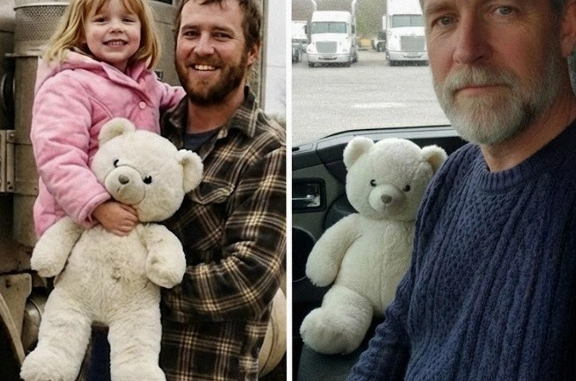
Grief is usually imagined as something explosive—sirens, shouting, the sound of a life breaking apart. When it finally reached me, it arrived quietly. It came wrapped in the steady drone of tires on asphalt and the burnt smell of coffee that had sat too long in a thermos. I’ve spent most of my life alone on the road as a truck driver, but nothing prepared me for the silence that followed losing my daughter, Emily.
A decade ago, I was new to the job and barely scraping by. Emily was about to turn four, and I wanted—needed—to give her something special. Her request was simple and impossibly big at the same time: a teddy bear “as tall as me.”
At a weather-beaten flea market outside Dayton, I found one. He was oversized, bright white, and imperfect—one plastic eye stitched higher than the other, giving him a look of constant curiosity. The woman selling him saw me counting bills and smiled. She charged me ten dollars and called it a “father’s discount.”
Emily named him Snow. From that day on, he stopped being a toy and became part of our family.
Snow became essential to our goodbye routine. Every time I left for a long haul, Emily would wrestle him to the truck and insist I buckle him into the passenger seat. I’d pull the seatbelt snug across his stuffed belly, and Snow would ride beside me, guarding the cab from loneliness. When I came home, Emily would undo the belt and proudly announce that he had kept me safe.
Even when she grew older—when everything I did became embarrassing—she never let that ritual go. Snow always came with me.
Emily’s mother, Sarah, and I didn’t survive the years of distance and exhaustion. There was no dramatic ending. We simply wore down. By the time Emily was twelve, we were divorced. Sarah hated the bear, thought it encouraged childishness, but to me, Snow was the only thing that made the truck feel like more than a job.
When Emily was thirteen, the ground shifted beneath us. Bruises appeared without explanation. She was always tired. Soon, our days revolved around hospital rooms, IV poles, and the sterile buzz of oncology wards. Emily, stubbornly bright, named her IV stand “R2-Drip2” and refused to let anyone treat her like she was already gone.
One night under harsh fluorescent lights, she held my hand and made me promise to keep driving. Two weeks later, she died.
After the funeral, I went numb. I stuffed Emily’s belongings into trash bags—markers, notebooks, pieces of a life that had ended too soon. When Sarah saw the bags, she accused me of erasing our daughter. I told her I was just trying to survive. After that, we barely spoke.
The one thing I couldn’t throw away was Snow.
I buckled him back into the truck and disappeared into the road for years—motels, highways, and endless miles blurring together. I told everyone I was fine.
Last week, while getting ready for a run to Colorado, panic hit me when I saw the passenger seat empty. Snow was gone. I found him buried in a closet under blankets, hidden there by my own unwillingness to feel. When I pulled him free, something inside cracked.
Running my fingers along his back, I felt something solid beneath the stuffing. I opened the seam carefully and uncovered a small envelope and a voice recorder. The recorder had a crooked label written in Emily’s handwriting: “For Dad.”
My hands trembled as I pressed play.
“Hi, Daddy.”
Her voice knocked the air from my lungs. She laughed, explaining that she and her mom hid the surprise because I was terrible at finding things. Then her tone softened. She told me she needed me to be okay—even if she wasn’t. She said she had buried something for me under the maple tree in the backyard, where we used to play baseball. The recording ended with her gentle command: “Keep driving. Don’t stay stuck.”
The envelope held a letter from Sarah. She explained that Emily had planned everything months earlier and made her promise not to tell me. Sarah had wanted to give me the bear after the funeral, but when she saw me throwing Emily’s things away, she was afraid I’d discard Snow too. She waited until I might be ready.
I went outside without a coat, dug beneath the bare maple branches, and hit plastic. Inside the buried box were Polaroids—me asleep on the couch, the two of us sharing milkshakes, Snow buckled into the truck. One photo shattered me: Emily in her hospital bed, bald, smiling, holding Snow up proudly. On the edge she had written, “Still magic.”
Her final note told me I was a good father, even when I didn’t believe it. And she gave me one last task: “Tell Mom you’re not angry. She cries in the car.”
The anger I’d carried for years dissolved instantly. I called Sarah. Her voice was guarded until I mentioned the magic. Then it broke. I told her I wasn’t mad. The sound she made—half sob, half relief—felt like something healing.
I drove to her house with Snow beside me. We stood on the porch, two people shattered by the same loss who had forgotten how to stand together. We apologized. We cried.
Snow is back where he belongs now, buckled into the passenger seat. The seam on his back is stitched closed, though the scar still shows.
When the road stretches on and loneliness creeps in, I remember her voice telling me to keep moving. I still drive.
But I’m not stuck anymore.
I’m just a father heading forward, with a reminder beside me that even when things break, the magic doesn’t disappear.