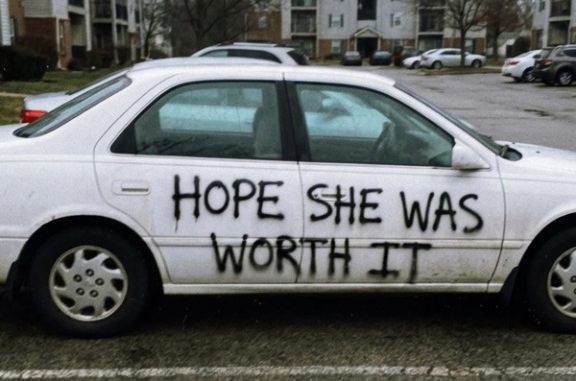
A marriage is built on trust, but even the strongest bonds can be shaken by a single false accusation. My name is Henry, and for three days, my life became a whirlwind of doubt, fear, and silence. I held my wife, Emily, as she sobbed into my chest—a mixture of relief and exhaustion after seventy-two hours of believing our relationship had been shattered. All because of four red-painted words scrawled across my car: “Hope She Was Worth It.”
I had never been unfaithful. Never even considered it. But seeing that accusation in public planted a seed of doubt that grew quickly, twisting every memory and interaction until our world felt unstable. As I held Emily, her pregnant belly pressed to mine, I realized how close we had come to losing everything.
The person behind this chaos was my sister, Claire. She stood across the living room, arms folded, masking a hint of guilt behind a façade of indifference. I demanded the truth—not for me, but for Emily.
Months ago, I had confided in Claire about my fears of becoming a father. Our own father had been emotionally distant, and I was terrified of repeating that pattern. I had sought comfort, not judgment. But Claire twisted my vulnerability into a story of betrayal in her mind. She decided to frame me as unfaithful, convinced that destroying my marriage would somehow “free” me.
Emily listened in stunned silence as the truth unfolded. I swore, hand to her face, on our unborn child, that I had never cheated. The relief on her face was palpable, but so was the trauma left by someone she trusted attempting to dismantle her world.
The night the message appeared, we had just returned from the obstetrician, thrilled to hear our baby’s heartbeat. The joy of that moment collapsed when I saw the words on my car. Emily’s mind raced with imagined betrayals; the trust we had built over six years shattered in seconds. She couldn’t ride home with me and called her mother instead.
I spent the night scrubbing paint from the car, my frustration matched by my sense of helplessness. Claire appeared, casually eating ice cream, and explained her logic: I was a coward who didn’t want the baby, and she had given me an “exit strategy.” Her lack of empathy was chilling, her pattern of manipulation familiar.
I took her to Emily’s parents’ house, armed with sunflowers and chocolate cake, hoping a face-to-face confession would repair the damage. In that living room, the truth emerged. Emily’s anger was sharp and justified—Claire’s actions were not protective but destructive.
Recovery wasn’t instant. We attended couples counseling, explored how trauma from false accusations affects relationships, and addressed our fears openly. Three months later, our daughter Sophie was born—a six-pound, nine-ounce symbol of resilience and love.
Our bond is stronger now. Communication is transparent, boundaries are clear, and trust has been reinforced. Claire is still on the periphery, under supervision during interactions with Sophie. I have learned the painful truth: not everyone you confide in has your best interests at heart. Some watch the fire just to feel in control.
The faint stain on the car is a reminder of what we survived. But our marriage now rests on a foundation more enduring than paint—a trust we have fortified, a love we have defended, and a family we refused to let be destroyed.