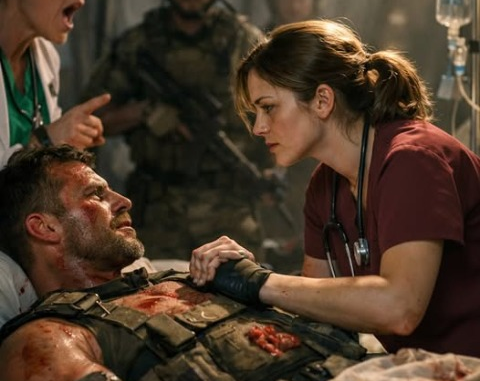
The ER at Mercy General Hospital buzzed with controlled chaos—sirens wailing outside, gurney wheels squealing, gloves snapping against skin. Among the flurry of motion, Dr. Lila Monroe was practically invisible. A quiet intern, she had mastered the art of blending in: brown hair tied messily, eyes downcast, always observing rather than being observed. Attention, she had learned, was dangerous.
At 10:17 p.m., everything changed. Paramedics burst in, shouting about a gunshot victim, unstable and pulseless. On the gurney was a heavily armored man, chest torn from the bullet’s path. Silver dog tags clinked with each movement. Lila’s stomach tightened. Senior Chief Daniel Cross, U.S. Navy, read her training instantly—she understood wounds civilians couldn’t.
Dr. Hargrove, the trauma attending, barked at her. “Step back, Monroe. First-year interns observe—this patient is too unstable.”
She complied, silently calculating the fatal error in his approach. Hargrove was about to open the chest at the textbook location—but the real bleeding wasn’t there.
Then Cross’s eyes snapped open. They weren’t weak or confused—they were deadly focused, locking on her. His hand, slick with blood, caught the hem of her coat.
“Valkyrie…” he rasped.
The word froze the room. That callsign was classified, a ghost from her past life as a combat medic. Hargrove paused, confused. Lila didn’t. She knew he had just named the one person capable of saving him.
Cross’s body went limp again, the monitor flatlining. The team scrambled, but she acted instinctively. “Move,” she said. Not a request. A command. She stepped forward, cutting a secondary incision precisely where battlefield training dictated.
Hargrove tried to intervene. “You’ll kill him!”
“I’m stopping the bleed you can’t see,” she replied, shoulder blocking him as her hands worked with lethal precision. She located the laceration in the left ventricle, applied unconventional pressure, and guided the internal paddles.
“Charge twenty. Clear!”
The flatline flickered, then a faint, uneven heartbeat returned.
“Sinus tach,” whispered a nurse, awestruck.
Lila worked tirelessly, suturing internal tissue with the skill of someone who had operated under fire. Hargrove could only gape. “No intern knows how to do this,” he muttered.
Lila looked up, exhausted but resolute. “I’m Dr. Lila Monroe. To the men I served with, I was Valkyrie. I’ve done this under worse conditions. I can handle this.”
The trauma bay went silent. The invisible intern had vanished. Lila had reclaimed her past, showing that a surgeon’s skill—and courage—can’t be erased. Cross was stable enough for the OR, and for the first time in years, Lila didn’t hide. She was exactly where she belonged.