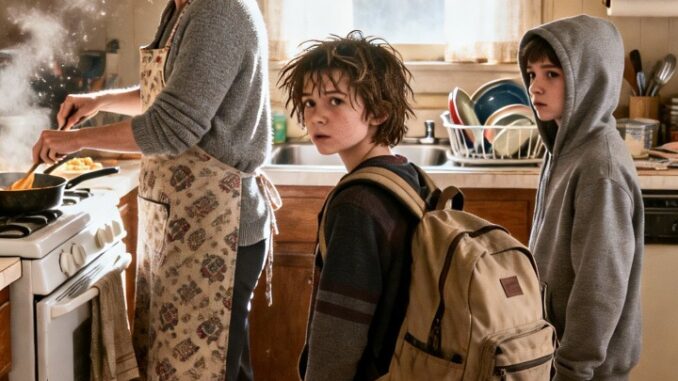
Trust often comes down to survival—balancing the dollars in your wallet against the bills on the table. For years, my husband Mark and I lived on that fragile edge, where a single unexpected expense felt catastrophic. So when my twelve-year-old daughter, Emma, appeared one evening three years ago with a quiet figure trailing behind her, my first reaction wasn’t sympathy—it was panic.
“She’s going to eat with us,” Emma declared. She didn’t ask. Behind her was Zoe, a girl swallowed in an oversized hoodie, even though the heat was sweltering. Her worn Converse were held together with tape, and her backpack looked as empty as her stomach.
I glanced at the pound of ground beef sizzling in the skillet—enough for our family of four—and felt the familiar anxiety of calculating how to stretch it. More beans, more rice, water in the soup… I smiled stiffly and invited her to join, but the meal was tense. Zoe ate like she hadn’t had a proper meal in days, flinching at every sudden movement.
When she left, I exploded. “We can’t afford this, Emma! We barely have enough for us!”
“She’s hungry, Mom!” Emma shot back, her voice fierce with frustration. “Her dad works sixteen-hour shifts to cover her mom’s hospital bills. She fainted in gym class yesterday because she hadn’t eaten in twenty-four hours. And she can’t tell anyone, or they’ll take her away from the only family she has left.”
Shame replaced my anger. I’d been worried about stretching dinner, while this child carried the weight of the world. From that night on, the rule was clear: Emma would bring Zoe every day.
For three years, Zoe became part of our daily life. She did homework at our kitchen island while I cooked. We never discussed hunger—it’s a quiet shame many families carry—but we added more water to the soup and adjusted our meals. Mark worked extra shifts, I clipped coupons, and we simply kept the food coming.
When Zoe graduated as valedictorian on a full scholarship, she handed me a card. Inside was a photo of her and her father. “You fed me eight hundred meals,” she said, her voice trembling. “You never reported us. You just made sure I had the strength to study. You saved us.”
Years later, history repeated itself. Emma called a week before Thanksgiving. “Mom, I’m bringing a friend home. He’s got nowhere to go—and he eats a lot.”
This time, I didn’t hesitate. I didn’t calculate the budget. I just said we’d need a bigger turkey.
When they arrived, Emma brought Lucas—a tall, quiet teen who seemed to shrink into himself. He wore a faded hoodie and carried nothing. Polite and wary, he referred to me as “Ma’am,” a formal courtesy shaped by a life of being treated like a burden.
At the Thanksgiving table, Lucas ate with a quiet, desperate intensity, reminiscent of Zoe years earlier. Later, I found him in the pantry, staring at the shelves as if memorizing their contents. “I wasn’t taking anything,” he said nervously, bracing as though he expected punishment. His apology struck me: he was sorry for feeling hungry. I reassured him he never needed to apologize for that.
Food insecurity is a hidden epidemic in America. According to the USDA, about 12.8% of U.S. households—roughly 17 million families—struggle to access enough food, with nearly one in five children affected. Families like Zoe’s and Lucas’s often work multiple jobs but are trapped by medical bills, rent, and rising costs of living. In 2026, the average Thanksgiving meal for ten has risen almost 30% in five years, making every “extra plate” a sacrifice.
That night, Lucas shared his story: a mother battling illness, a father unemployed after a factory closure, and the stigma of free lunch programs. Listening, I realized the greatest gift Emma had given us wasn’t feeding someone—it was opening our eyes. We saw that independence is often an illusion; we all rely on others to survive.
The next morning, I watched Emma and Lucas laughing over leftover pie. He seemed more present, more grounded, his shoulders finally relaxing.
We often preach self-reliance, but as Zoe once said, you can’t lift yourself if you’re too weak to stand. Sometimes, the most radical act of defiance against a harsh system is as simple as offering a warm plate of food—without a question, without judgment.