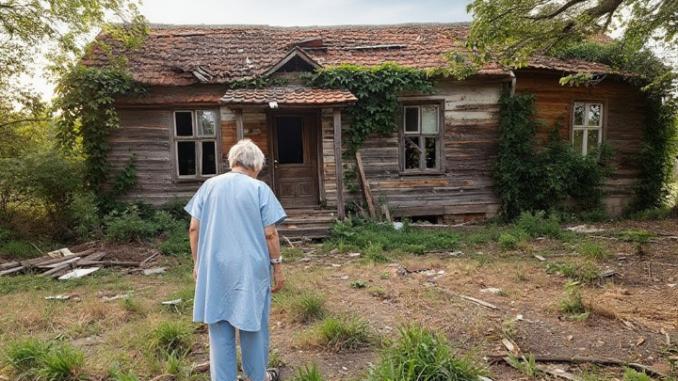
For thirty years, Margaret Holloway had been trapped in a world where her own voice was treated as a symptom. At seventy-two, she sat by the narrow, barred window of Riverside State Psychiatric Hospital, watching autumn leaves drift like whispered confessions. Inside the ward, the story was clear: Margaret was delusional, her memories unreliable, and the house she claimed to own existed only in her imagination. Her hands, blue-veined and trembling with age, folded a long-hidden piece of paper—the deed, typed neatly: Margaret Anne Holloway. Owner.
The staff said she was lost in her own mind. Margaret knew otherwise. She understood that someone else had manufactured the fog of confusion that enveloped her. On a misty morning, before the nurses finished their rounds, Margaret Holloway did the impossible: she walked out of the life imposed upon her.
Three decades earlier, Margaret had lived with quiet order. As the librarian in Millbrook, Pennsylvania, she found comfort in the predictable rhythm of books, floorboards, and the two-story Victorian she inherited on Hawthorne Lane. Every detail mattered—from the precise eggshell blue of the kitchen walls to the third stair that groaned beneath her step.
Then came her sister, Elaine. A forceful, ambitious presence, she arrived one winter with a suitcase and a husband Margaret distrusted, bringing concern that masked control. “You’re forgetting things, Maggie,” Elaine would say, her voice sweet but toxic. “It’s unsafe to be here alone.”
Margaret protested, but Elaine’s plans moved faster than logic. Doctors, briefed by Elaine, declared Margaret unfit. One night, she was taken for an “evaluation”—and she never returned to the kitchen she knew.
In the hospital, time flattened. While the world outside changed, Margaret aged behind walls of medication and dismissal. Her attempts to speak truth were written off as delusions. Elaine stopped visiting. Margaret’s home was supposedly sold, records lost in a “fire,” her life erased. Yet Margaret never abandoned one fact: the house still existed, and it was hers.
The spark for escape came from overhearing two young orderlies gossiping.
“Still empty,” one said. “Looks like a tomb. Surprised it hasn’t been torn down.”
That night, Margaret planned. She memorized shifts, hallway creaks, and the service door left ajar for deliveries. At dawn, she donned a thin coat, tucked the deed in her shoe, and stepped into the free air.
Her journey was grueling. Bus rides, miles of walking, legs burning—but finally, she turned onto Hawthorne Lane. There it stood: her Victorian, patiently enduring decades of neglect. Ivy clung to the siding, boards covered the windows, yet the house’s essence remained unmistakable.
The front door resisted, warped with years of weather, but it gave way with her shoulder. Inside, dust hung thickly in the air, but the home still spoke. The piano’s ivory keys had yellowed, the kitchen paint faded to gray—but the rooms seemed to inhale with her presence.
She went straight to the staircase, seeking the secret panel she had built with her father as a girl. The latch crumbled, revealing not books, but boxes—her hidden history. Inside were letters from independent evaluators proving her competence, legal filings never seen by a judge, and at the bottom, a leather-bound journal.
Elaine’s handwriting, frantic and jagged, confessed everything: the motive, the deception, the falsified psychiatric claims. Margaret sank to the floor, realizing she hadn’t been insane—she had been the victim of calculated betrayal.
A knock interrupted her thoughts. A city inspector, called by a neighbor, warned her the property was condemned. Margaret stood tall, clutching her journal and deed. “I am Margaret Holloway,” she declared. “I am home.”
The legal reckoning shook Millbrook. Elaine’s deceit was undeniable; the hospital faced reform. Margaret received restitution, though she told reporters, “Money cannot replace thirty years of wind in these trees. I wasn’t lost—I was buried alive.”
Margaret spent her final years as a local legend, restoring the Victorian and volunteering at the town library. She never married, never left the house, and ensured the hidden room remained intact, a testament to the truth she had reclaimed. When she passed at eighty-two, she left the house to the Millbrook Historical Society with one condition: the hidden room remain open, so all could see that truth has no expiration—and the bravest act is to refuse the lies told about you.