My wife casually brought up her twenty-year reunion while folding laundry, as if feeling out my reaction.
“They’re having a reunion,” she said quietly. “I thought I might go.”
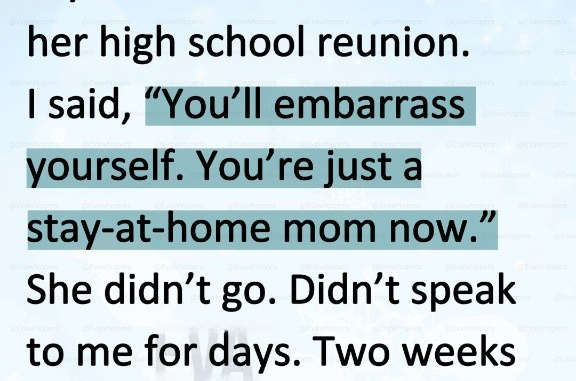
I didn’t even glance up from my phone. The words came out sharper than intended. “Why? Just to make a fool of yourself? Everyone else is probably a CEO or lawyer by now. You’re just a stay-at-home mom.”
Silence filled the room.
I expected a rebuttal, maybe a small argument—but she simply nodded. Not agreement, but resignation. Quiet, weighty, final.
“Oh,” she said. “Okay.”
She didn’t attend. And for days afterward, she barely spoke to me. No yelling, no door slams—just a polite, distant efficiency. She answered questions, managed schedules, handled dinner—but her gaze passed right through me, like I was invisible furniture.
I convinced myself she was being sensitive. I told myself I was being realistic. Reunions didn’t matter anyway.
Two weeks later, a delivery truck arrived, dropping off a large cardboard box addressed to her. She wasn’t home.
Curiosity—and guilt—won. I cut the tape.
Inside were stacks of plaques, awards, and hardcover books. I lifted one at random: “National Science Fellowship — Recipient.” Another: “Published Research Award — Top Citation Impact.”
Then I saw it—her photo on the book cover. Younger, yes, but unmistakably her. The bio described a groundbreaking researcher, a top innovator in her field, whose work had influenced policy—all under her maiden name.
I sank to the floor.
At the bottom, the reunion program booklet awaited. A handwritten note explained she had been invited to speak in recognition of her achievements.
When she returned home, she found me there, surrounded by evidence of a life I hadn’t acknowledged. She didn’t seem surprised.
“I wondered when you’d open it,” she said, calm, arms crossed.
I choked out, “Why didn’t you tell me?”
“I did,” she replied. “Years ago. You said staying home made more sense. Someone had to put the kids first.”
The weight of my oversight hit me. She hadn’t stopped being brilliant—she had simply been invisible to me.
She ran her thumb over one of the plaques. “I didn’t speak to you because I was mourning—not my career. My marriage.”
That night, she slept in the guest room.
I finally understood: I hadn’t married just a stay-at-home mom. I had married a woman who had sacrificed her own acclaim for love and family, trusting me not to dismiss her in the process.
And the hardest truth? The most humiliating part of that reunion wasn’t her absence—it was my blindness to the woman I’d married all along.