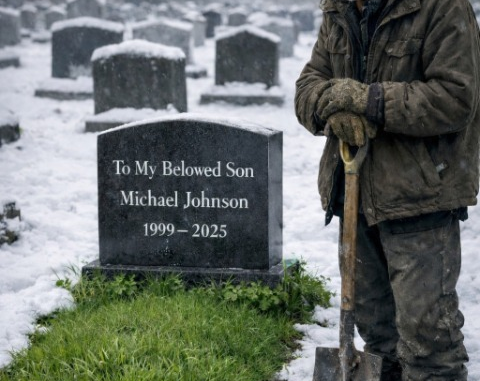
The frost at Willowbrook Cemetery was more than a chill; it devoured everything in its path. By mid-January, the soil hardened into a near-impenetrable slab, and the grass turned brittle, a lifeless tan under the relentless cold. Thomas Hartwell, the cemetery’s caretaker for more than thirty years, had walked every acre, memorizing its quirks—the sunless corners, the spots that pooled water after spring melts. He had witnessed grief in every form: widows bringing fresh tea to headstones, parents leaving soggy, decaying toys in the rain.
Yet Plot 47 in Section C was unlike anything he had ever encountered.
The grey granite headstone bore a familiar name in Thomas’s ledger: Marcus James Whitman, 1999–2025. Twenty-six years—far too short for a life—but that alone didn’t command attention. What caught Thomas’s eye was the patch of grass surrounding the grave: a vivid, almost aggressive green that seemed impossibly alive.
In the bitter cold of 2026, when temperatures plunged to fifteen below zero, Willowbrook lay under a thick blanket of snow. Every other grave was trapped beneath ice and frost, yet Marcus’s plot remained untouched. The grass was lush, springlike, even warm under Thomas’s touch. He knelt and pressed his hand to the earth, feeling heat radiating from below—a faint, persistent warmth that contradicted the season.
Thomas’s rational mind searched for an explanation. Perhaps a wealthy family had installed some sophisticated memorial device. He had seen solar lanterns and digital tributes before, but this felt extraordinary. For four mornings, he watched the plot before dawn, flashlight cutting through mist, expecting to catch someone tending the ground. But no footprints, no tire tracks, no human presence—just warmth. The heat seemed intrinsic, as if the grave itself resisted winter.
On the fifth day, curiosity and professional concern drove him back with a spade. He knew the rules about disturbing graves, but this anomaly was extraordinary. The shovel sank into thawed earth, encountering no frost. Three feet down, it struck a black, weatherproofed metal box, wires trailing toward the old chapel at the cemetery’s heart.
Tracing the cables, Thomas discovered a hidden junction behind a holly bush. A single breaker was meticulously labeled: “Section C-47.” Someone had wired the grave for warmth—professionally, deliberately.
Three days later, the man behind the mystery revealed himself. At dawn, Thomas spotted a thin, elderly figure at the plot, staring intently at the grass.
“Mr. Whitman?” Thomas called.
The man turned. Weathered, exhausted, yet with eyes sharp and steady. “You found it,” he said simply.
“I did. But you can’t just heat a cemetery,” Thomas replied.
David Whitman knelt at the edge of the vibrant patch. “Marcus hated winter. From a boy, the frost made him quiet. He called it the ‘season of bone.’ When he died in March, I couldn’t bear the thought of him returning to that cold. So I made this.”
He explained the installation: $8,000 for the system, powered by the chapel’s auxiliary line, paid quietly each month. It wasn’t logical. It didn’t stop the cold from touching the rest of the cemetery. But in this small rectangle of life, David could imagine Marcus still basking in warmth, still being protected.
Thomas studied the green plot, contrasting it against the frozen expanse surrounding it. Regulations be damned, he realized: this was more than a memorial. It was a father’s refusal to relinquish care. Thirty-three years as a caretaker had shown him many tributes, but never one that celebrated love in motion, not just memory.
“The wiring?” Thomas asked cautiously.
“Industrial grade,” David confirmed.
“I’ll need schematics for my records, and the electrician’s name,” Thomas said. “I can’t have a live circuit failing under snow.”
David exhaled, relief softening his features. “So… you’ll let it remain?”
Thomas smiled faintly. “I’ve got fifteen years left on these keys. While I’m here, Section C-47 stays warm. You can sit in the sun for a while longer.”
As the first sun of the morning painted the snow in gold and violet, the two men stood quietly, watching heat rise from the grave in a faint, shimmering haze. Thomas understood that his duty extended beyond stone and turf; it was to guard stories that refused to succumb to winter.
The grave that never froze became a whispered legend among locals who braved Willowbrook in winter. But for Thomas and David, it was simply love made manifest. In the heart of 2026’s harshest cold, one father’s devotion kept a small patch of earth alive—one watt at a time.