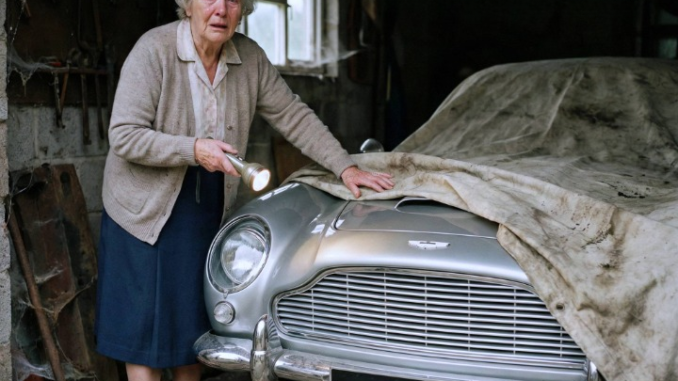
The garage smelled like a mix of stale motor oil and the sharp metallic bite of dust left untouched for years. I stood in the shadows, fingers fumbling over a jagged, unfamiliar key, while my son’s last words echoed relentlessly in my mind.
“You’re useless, Mom. What could you possibly do with a real inheritance? Dad knew that.”
The lock gave way with a heavy industrial click. As I pushed the door open, the hinges groaned in protest—a soundtrack to the wreckage of my forty-two-year marriage. I flicked on my flashlight, expecting nothing but rusted tools and forgotten junk. Instead, the beam caught a flash of chrome that made my chest tighten.
To understand the shock, you need to know how I ended up homeless on my birthday, clutching a single suitcase and a brass key that mocked decades of sacrifice for my family.
It began that morning in Mr. Hoffman’s mahogany-paneled office, our family attorney. Jonathan, my son, sat across from me in a sharp Italian suit, all corporate poise. I felt small in my black dress, the one I had worn to my husband Robert’s funeral three weeks earlier.
“Before reading the will,” Mr. Hoffman said, adjusting his glasses, “these instructions were drafted clearly by Mr. Campbell.”
The legal language blurred until the bombshell landed: Jonathan inherited the penthouse and primary investments. I was left with the property at 1420 Industrial Parkway—the garage and whatever it contained.
Jonathan’s smug chuckle broke the silence. He squeezed my shoulder, a gesture more threatening than kind. “Don’t worry, Mom,” he whispered. “I’ll make sure you’re taken care of.”
But “taken care of” meant eviction. That evening, he dropped my suitcase in our marble foyer and announced I could stay with Aunt Helen—or take the “dump” of a garage.
Fueled by shock and defiance, I went straight to the garage.
Inside, three shapes under custom cloths shimmered under my flashlight. The first revealed a 1964 Aston Martin DB5 in pristine Silver Birch. The second, a 1956 Mercedes-Benz 300SL Gullwing, deep blue and flawless. The third, a 1967 Ferrari 275 GTB/4, red as a heartbeat.
A light switch flooded the garage with recessed LED illumination. It wasn’t a garage—it was a climate-controlled vault. Taped to the wall was an envelope in Robert’s handwriting.
“My Dearest Susan,” it began. Robert had known his diagnosis and had feared leaving Jonathan unchecked. The letter explained that if everything passed directly to me, Jonathan would have manipulated and drained it.
“The cars are worth twelve million,” the letter stated, “and that’s just the start.”
Behind a photograph of us in Venice, a digital safe waited. Using our anniversary as the code, I opened it to find a leather portfolio: deeds to apartment buildings in Seattle, retail spaces in Chicago, a boutique vineyard in Northern California—all in a Living Trust for me alone. The most touching item was a small cottage in Carmel-by-the-Sea, our happiest getaway.
That first night, I stayed in a hidden office within the garage. Robert had even stocked clothes with tags still on. It wasn’t just wealth—he’d left me a fortress of dignity.
The next morning, Marcus Weatherby, the curator Robert hired, explained the collection. “Robert was methodical,” he said. “He wanted to give you something tangible that would grow in value. He called it your ‘Independence Fund.’”
My phone rang. Jonathan: “Mom? Why aren’t you at Aunt Helen’s? You need to clear out your stuff at the penthouse.”
“I’ll be there,” I said, steadier than I’d been in years.
At the penthouse, Jonathan barked orders into his headset. “Did you sleep in your car, Mom? Honestly, just listen to me—”
“I’m not here to listen,” I said, handing him a folder. “Inside is the deed to Carmel and the summary of the Living Trust. Your ‘garage’ had more than oil in it.”
He leafed through the papers, color draining. Twelve million in cars, forty million in real estate, dividend income far above his salary.
“This… this must be a mistake,” he stammered.
“No mistake,” I said. “The penthouse is yours. But I have a life to live.”
I walked to the elevator. “Dad gave you what you wanted: status. But he gave me the life. And I’ve ensured my estate bypasses you entirely.”
As I drove toward the coast, the brass key glinting on the seat, I realized Robert’s long game of love and foresight had just begun to reveal itself. I wasn’t just surviving—I was finally starting, with twelve million dollars of vintage cars behind me and a horizon entirely my own.