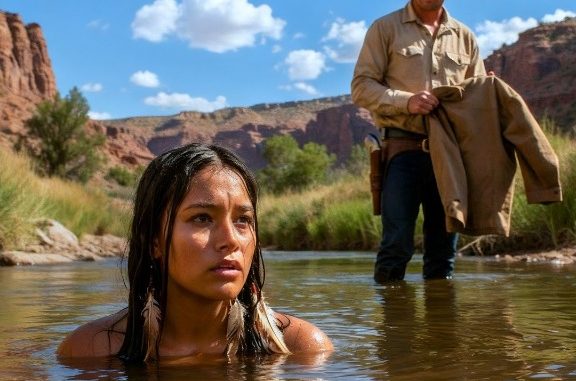
The late afternoon sun was sinking over the northern pasture when Cole Merrick noticed movement near the creek. After a long day checking fences, tightening wire, and inspecting water troughs, all he wanted was a quiet evening and a warm meal. Instead, he saw a figure in the shallow water among the cottonwoods.
At first, he thought it was a deer—but then the figure shifted.
A young woman stood waist-deep in the creek, her dark hair wet and tangled, her dress torn and clinging to her bruised shoulders. Her bare feet were scraped and bleeding. When she saw him, she froze, like a frightened deer.
“They stole my clothes, cowboy. Please… help me,” she said, voice breaking.
Cole didn’t rush. Years of scouting for the army had taught him that fear could make people unpredictable. Three years prior, he had buried his wife during a fever outbreak and retreated to the quiet of ranch life. He trusted little and spoke less.
But the desperation in her eyes broke through his caution.
He slowly removed his coat and held it toward her. She hesitated only a moment before grabbing it, wrapping herself tightly. Up close, Cole saw rope burns and scratches along her ribs. Someone had treated her roughly.
He helped her out of the creek and lifted her onto his horse when she couldn’t walk. Clinging to him, she rode silently as he guided them back to his cabin.
Inside the modest cabin—a table, two chairs, a narrow cot, and a stove—Cole lit a lantern and built a fire. He gave her a blanket and turned away while she adjusted the coat. Quietly, he began mending her torn dress. She watched him, assessing every movement.
That night, Cole didn’t sleep. He sat by the door, rifle across his knees, listening to every sound beyond the walls. He had tended wounded men before, but this felt different—her attackers might return.
Morning brought coffee and questions.
“You got a name?” he asked.
“Nia,” she said, keeping her sentences short. She explained that three white boys had attacked her near town, mocking her, stealing her belongings, and leaving her by the creek. One was named Clay.
Cole knew the name—trouble ran in that boy’s family. He weighed the risks. Taking her into town could raise questions; leaving her alone meant danger.
“You can stay here a while,” he said. “Until it’s safe.”
She eyed him warily. “Why?”
“Because I don’t let folks starve on my doorstep.”
That was enough for her.
Over the next few days, Nia helped around the cabin despite her injuries. She limped beside him while he checked fences, repaired tools, and tended the animals. She cleaned, cooked, and mended clothing, but kept alert, always scanning the trees.
“You don’t have to keep looking over your shoulder here,” Cole told her.
“I keep watch for myself,” she replied.
Cole respected that—but he kept the rifle close.
On the third morning, he rode into town before dawn.
“Clay,” she said, tense.
“Better I find out than wait for him to show up,” Cole said.
At the saloon, he spotted Clay and another boy. Their laughter faded when they saw him. Cole called them out, warning them that if they returned to his land, they wouldn’t leave alive. Silence followed. The threat was understood.
Returning to the ranch, Cole found Nia waiting on the porch. Relief crossed her face when she saw him.
“They know you’re here,” he said.
“But they won’t come,” she asked.
“Because I made it clear,” he replied.
That night, the cabin felt quieter. Nia no longer flinched at every sound. Trust was growing. Her laughter, brief and unexpected, reminded Cole that the emptiness of his ranch was fading.
As the sun dipped low again, Nia stood beside him, watching the golden horizon.
“You don’t have to stay,” he said.
She considered him for a long moment. “Maybe I stay,” she said.
Cole nodded. He knew better than to rush trust. But if the men ever returned, they would find more than a frightened girl—they would find Cole Merrick, ready.