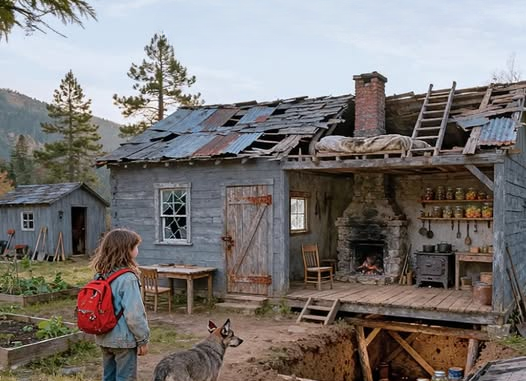
The shift from the bright buzz of a Montana gas station to the hushed, pine-filled stillness of a mountain cabin was more than a change of scenery for eleven-year-old Ava Thompson—it was an act of survival. In early 2026, her world had already begun to unravel. Standing near pump number four, she watched her mother’s car disappear into the fading light. She waited. Twenty-three minutes passed before the truth settled in with quiet certainty: her mother was not coming back.
In Ava’s short life, the phrase “I’ll be right back” had often meant something was about to change. This time, it meant everything.
Her father had died in Afghanistan three years earlier, and his absence had hollowed something out inside her mother. Letters stopped arriving. Benefits became tangled in paperwork. Stability dissolved into motel rooms and borrowed couches. That February night, abandonment followed Ava into the mountains. She understood enough about the world to know a gas station after dark was no place for a child alone. Trusting instincts shaped by loss, she shouldered her backpack and stepped into the trees.
A dirt service road climbed away from the highway’s glow and into deeper silence. After walking nearly half a mile, she found a log cabin with a metal roof and a still American flag hanging from its porch. It felt solid and hidden, like a place built to endure. The cold pressed in, leaving her with little choice. Carefully tapping a cracked windowpane with a rock, she slipped inside.
The cabin’s interior reflected the life of someone who had once worn a uniform. Military photographs lined the walls. Medals rested in precise rows behind glass. A folded flag stood framed with care. The air smelled of cedar and leather. This was the home of Caleb Jennings, a former soldier who had served two overseas tours before retreating to the mountains, seeking quiet after a life shaped by noise and loss.
Ava gathered kindling and lit the stove the way she remembered her father doing years ago. As warmth filled the room, she whispered, “This will be our sanctuary,” unsure who “our” truly meant anymore. Still, the word offered comfort.
Morning brought the sound of the cabin door opening. Caleb stepped inside and found his solitude interrupted by a small girl beside a lit fire and a broken window. The silence between them stretched for a few seconds, heavy with unspoken histories. Caleb saw abandonment etched in her expression. Ava saw caution and strength in his.
“I got left,” she said simply.
The words struck him deeply. He understood what it meant to feel forgotten—by systems, by circumstances, even by people. He didn’t shout about the glass. He didn’t call the authorities right away. Instead, he added another log to the stove and asked if she was hungry.
Over the next few days, the cabin slowly changed. It no longer felt like a place of retreat but one of rebuilding. Caleb offered structure instead of promises. He taught Ava how to split wood, how to read the sky for signs of weather shifts, and how to keep a house running smoothly. In return, her presence softened the edges of his isolation. He began to see that hiding in the mountains had been his way of avoiding life.
They were both navigating loss. Caleb’s steady discipline gave Ava a sense of safety. Ava’s quiet resilience reminded Caleb that connection was still possible. In the stillness of the mountains, they discovered that healing doesn’t happen alone—it happens when two people choose to stand beside each other.
As the months passed, authorities were eventually notified to address Ava’s abandonment. Caleb stepped forward as her advocate, guiding her through the foster system’s complexities with calm determination. What began as an emergency shelter became something deeper.
The cabin transformed into more than a wooden structure in the woods. It became proof that sanctuary is built through consistency, trust, and care. Ava’s mother never returned. But a soldier did—not just from war, but from the emotional distance he had placed between himself and the world.
Ava learned that while some people leave, others remain to keep the fire burning. Caleb realized his most meaningful mission would not earn medals or recognition. It would be the quiet commitment to show up every day for a girl who once sat alone on a curb, counting the minutes of her own disappearance.
In time, neither of them were defined by abandonment or isolation. They were simply home.