At twenty-four, I didn’t just lose my job. I lost my sense of stability, my pride, and the belief that sheer determination could keep my life from falling apart.
Within a few weeks, I found myself living out of my car, my two young children curled up in the back seat. I told them we were “camping,” forcing cheer into my voice while silently trying to prevent our lives from unraveling completely.
Eventually, desperation outweighed pride.
I drove to my mother’s house.
When she opened the door, she looked smaller than I remembered—thinner, shoulders slumped, eyes heavy with fatigue—but still carrying that familiar warmth that had once made everything seem solvable.
Words poured out of me before I could stop them. I explained losing my job, the eviction, washing up in gas station bathrooms, and sleeping under streetlights because it felt safer than hidden corners.
“I don’t have anywhere else to go,” I finished, my voice breaking.
She paused.
A pause that would haunt me for years.
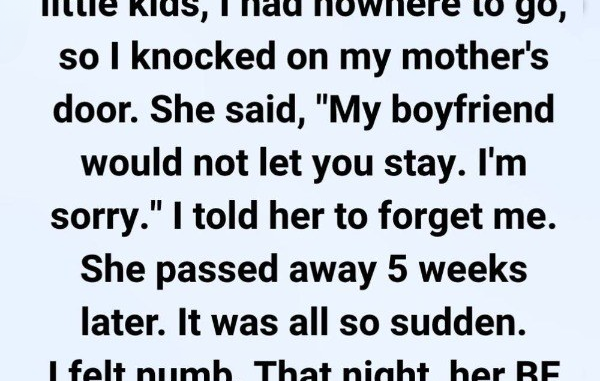
“My boyfriend,” she said quietly, clutching the doorframe. “He wouldn’t allow it. I’m so sorry.”
It felt like the floor vanished beneath me.
For a moment, I couldn’t breathe.
“Then forget about me,” I whispered, turning before she could see my face crumble. Every step back to the car felt unbearably heavy.
Over the next few days, my phone constantly lit up with her name: missed calls, texts, voicemails that began steady and dissolved into trembling silence.
“Please, sweetheart. Just come talk to me. Please.”
But I was too hurt. Too angry, convinced that if she truly loved me, she would have chosen me over anyone else. So I didn’t answer.
Five weeks later, the call came.
She was gone.
A heart condition, they said. Sudden, but not entirely unexpected.
At her funeral, her boyfriend approached me, voice unsteady and eyes red.
“She wanted to tell you,” he said. “But you wouldn’t answer.”
Before I could react, he handed me a worn fabric bag. My name was stitched on it, slightly uneven, as if hurried but with care.
“She made this for you,” he said softly. “She said you’d need it someday.”
My hands shook as I opened it. Inside were tiny crocheted hats, soft sweaters, delicate blankets—each labeled with my children’s names in her handwriting.
Among the yarn were letters, written months before, revealing her diagnosis. She explained that she hadn’t told me because she didn’t want my last memories of her to be hospital machines and oxygen tubes. She didn’t want my children to associate her with fear or weakness.
“I wanted you to remember my laughter,” she wrote. “My Sunday mornings in the kitchen. The way I danced with you when you were little. I didn’t want my leaving to weigh heavier than it already would.”
I read that line again and again.
The anger I’d carried softened. She hadn’t rejected me—she had been trying, in her own imperfect way, to protect me, even at the cost of saying goodbye properly.
In the weeks that followed, I replayed that afternoon at her door: the tremble in her voice, the way she looked like she wanted to say more but held back. Maybe she was sparing me another burden. Maybe she thought there would be more time.
Now, when I wrap my children in the blankets she made, I tell them about their grandmother: strong in quiet ways, loving even when she couldn’t show it perfectly. I tell them about Sunday pancakes, off-key singing, and the gentle squeeze of her hand when I was afraid.
Every night, after they fall asleep, I fold her tiny sweaters with care and whisper into the dark:
“I’m sorry, Mom. I understand now.”