A crowded cross-country flight is not where most people expect a life-altering moment. For Noah Granger, it was simply a necessary trip—one that would take him and his eight-year-old daughter, Lily, from their fractured life to his parents’ home in Denver. The cabin air was stale, the seats cramped, and every passenger seemed locked inside their own private concerns.
Noah sat squeezed into a middle seat, watching Lily clutch a small bag of gummy bears as if it anchored her to something steady. Since losing his wife, Elena, months earlier, Noah had moved through life in a haze of exhaustion and quiet grief. Elena had been a nurse, practical and compassionate, always insisting that kindness required more strength than anger. “Anyone can be hard,” she used to say. “It takes courage to stay gentle.”
Midway through the flight, a disturbance rippled through first class. A woman—elegant, composed in appearance but visibly shaken—was struggling to contain her tears. While others turned away, uncomfortable with such open sorrow, Noah recognized the look in her eyes. It was the same hollow weight he had carried since Elena’s passing.
During boarding, he had offered her a small nod—nothing dramatic, just silent acknowledgment. No pity. No curiosity. Only recognition.
Later, as the plane cruised over the Rockies, a flight attendant approached Noah with a folded note. Inside, written in careful but trembling script, were simple words: gratitude. The woman thanked him for seeing her as human in a moment when she had felt exposed and ashamed of her grief. She mentioned that he had done so in front of his daughter, without spectacle or expectation.
Noah read the note twice. He hadn’t realized that eye contact and quiet respect could matter so deeply.
Lily read it too and looked up at him. “You made her feel seen,” she whispered.
After landing in Denver, the encounter seemed destined to fade into memory. The woman passed them in the terminal, placing her hand over her heart in silent thanks. Then she disappeared into the crowd.
Noah and Lily spent the next few days with his parents before retreating to a modest mountain cabin Noah had been restoring. Repairing beams and patching walls had been his way of rebuilding something solid while everything else felt uncertain.
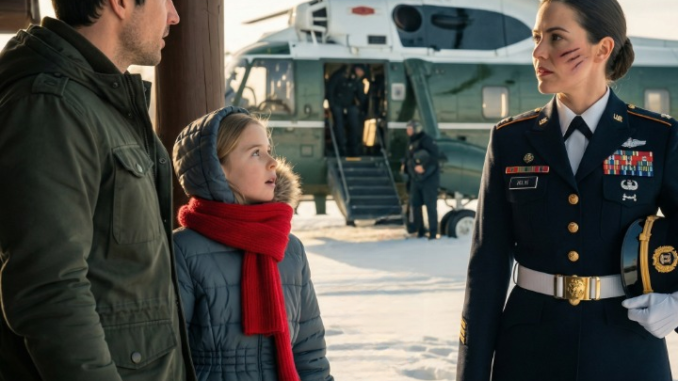
On their third evening in the mountains, the stillness was shattered by the rhythmic thunder of rotor blades. At first, Noah thought it was a distant storm. But the sound intensified, and searchlights cut through the trees as a private helicopter descended into the clearing near the cabin.
When the aircraft landed, pine needles swirling in its wake, the woman from the plane stepped out.
She introduced herself properly this time. Sienna wasn’t simply a passenger—she led a major philanthropic foundation. Her grief, she explained, had been personal and immediate. Noah’s small act of quiet compassion had met her at her lowest point.
She hadn’t returned for spectacle. She had come with purpose.
Sienna told Noah she wanted to fund a new medical initiative in honor of Elena—a project aligned with the kind of community-based healthcare Elena had always believed in. She had used her resources to find him not to repay kindness with extravagance, but to transform a fleeting human moment into something enduring.
Standing on his porch as the helicopter blades slowed, Noah realized something profound. He had not set out to change anyone’s life that day on the plane. He had simply chosen not to look away.
In a world that often feels rushed and divided, that choice mattered.
The mountain air grew quiet again after Sienna departed, but the silence felt different. It no longer carried only absence. It carried possibility.
What began as a small exchange between two grieving strangers became a bridge—between loss and purpose, between empathy and action.
Noah understood then that legacy is not built in grand gestures. It begins in ordinary spaces—like an economy seat at 30,000 feet—when someone decides to meet another person’s pain with steady kindness.
And sometimes, unexpectedly, kindness finds its way back.