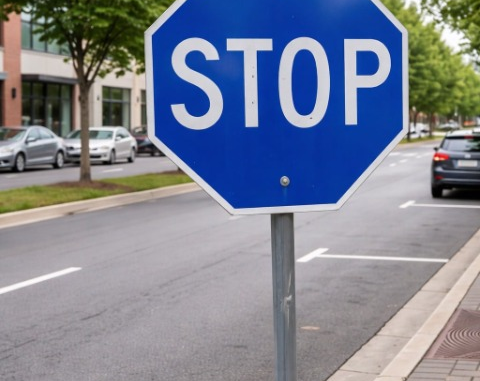
For most drivers, the familiar red stop sign is almost instinctive. Its bright color immediately signals that drivers should slow down and be ready to stop. In the United States, official traffic rules require stop signs to follow a standard design—red with white letters—so they are easy to recognize in any situation. Organizations like the Federal Highway Administration establish these rules to keep road signs consistent and improve safety on public roads.
Occasionally, however, drivers may come across blue stop signs, which can be unexpected. These signs are usually found in places such as private neighborhoods, company campuses, shopping areas, or large parking lots. Because they are placed on private property rather than public streets, they are not required to follow the same federal design standards used by local or state transportation authorities.
Although blue stop signs may not have the same legal status as the official red ones used on public roads, they still play an important role. Property owners install them to manage traffic movement, reduce the risk of accidents, and remind drivers to slow down in areas where pedestrians, parked cars, or narrow turns are common. In crowded places like parking lots, paying attention to these signs can help avoid confusion and potential collisions.
From a safety perspective, the smartest choice is to treat every stop sign the same, no matter its color. Stopping fully, watching for pedestrians, and checking for other vehicles helps protect everyone on the road. Even if the color is different, the message behind the sign is the same: drive carefully and keep shared spaces safe.