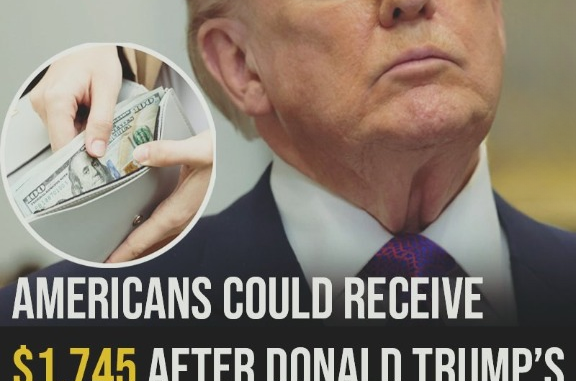
For months, Americans have heard claims that families could receive around $1,745 linked to tariff policies promoted by Donald Trump. However, it remains uncertain whether any such payments will actually reach households.
The idea originates from Trump’s focus on tariffs as a central part of his economic approach, along with suggestions that increased consumer costs caused by those tariffs could eventually be offset through direct payments to the public. Early discussions framed this as a “dividend”-style payout, similar to stimulus checks previously proposed, where tariff revenue would be redistributed back to Americans.
That concept has since faced a major legal setback. In early 2026, the U.S. Supreme Court ruled that the president lacked authority under the International Emergency Economic Powers Act to impose certain broad tariffs. This decision effectively invalidated key tariffs introduced in 2025 and undermined the legal basis for funding any direct payments from those revenues.
As a result, the original dividend-style plan is no longer viable in its initial form. Instead, policymakers are now discussing a different approach—one that resembles a refund rather than a bonus payment.
According to estimates from the Joint Economic Committee, American consumers paid roughly $231 billion in tariff-related costs over a one-year period, averaging about $1,745 per family. This figure has fueled calls for reimbursement.
Several political leaders, including Gavin Newsom and J.B. Pritzker, have urged the government to return these costs to families. Some lawmakers have even proposed legislation—the Tariff Refund Act of 2026—which would require tariff revenues to be repaid with interest within a set timeframe.
Supporters argue that since consumers ultimately bore the cost of tariffs through higher prices, they should be reimbursed to ease financial pressure.
However, officials and policymakers have expressed skepticism. The U.S. Department of the Treasury has indicated that significant legal and logistical challenges remain, making any direct payments uncertain for now.
Efforts are underway to create systems for processing refunds, but early reports suggest technical limitations. An online portal expected to launch in 2026 may initially struggle to handle a large portion of claims, potentially delaying the process further.
Another complication is that the Supreme Court ruling did not explicitly require refunds—it only invalidated the legal authority behind certain tariffs. This leaves open the question of who, if anyone, should receive repayment.
There is also ongoing debate about eligibility. Importers, who directly paid tariffs, may have stronger legal claims, while consumers—who indirectly absorbed the costs through higher prices—present a more complex case for reimbursement.
Tracking who ultimately bore the financial burden adds another layer of difficulty, as businesses often passed tariff costs down the supply chain. Determining fair distribution would likely require new legislation and detailed economic analysis.
Although Trump has suggested that potential payments could begin around mid-2026, that timeline remains speculative. Legal hurdles, administrative challenges, and policy decisions still need to be resolved.
For now, the idea of a $1,745 payment remains just that—an idea. Whether it becomes reality will depend on future court rulings, legislative action, and the government’s ability to implement a workable system.
The broader debate highlights ongoing questions about trade policy, economic impact, and the limits of presidential authority. Until those issues are settled, any promise of tariff refunds remains uncertain.