I’ve always believed I was pretty hard to rattle. Nearly sixty years old, three grown kids, thirty-plus years of marriage, and a lifetime spent teaching teenagers to read Shakespeare without falling asleep—after all that, you start thinking you’ve seen it all.
Then life laughs in your face and proves you wrong.
My mother is eighty-two. Bright-minded, sharp-tongued, and physically fading in all the ways that scare adult children. In January, she fractured her hip after slipping in her kitchen. One minute she was lecturing me about buying generic peanut butter, the next she was reliant on a walker and buried under a schedule of pills and appointments.
Dad passed ten years ago. Mom stayed in their house—paid off, comfortable, and cushioned by the nest egg he carefully built. People in our small town always knew she was comfortably well-off, even though she still clipped coupons like it was the Olympics.
When the hospital recommended getting in-home help, the guilt hit me instantly. Mark and I both work full-time. My kids live in three different states. Mom didn’t need a facility, but she needed more help than I could give between grading essays and trying to remember what defrosted chicken was supposed to become.
Enter Alyssa.
Twenty-six. Quiet. Efficient. She showed up in crisp scrubs with her hair in a perfect bun and a binder—an actual binder—full of notes and a proposed care schedule. My mother was smitten by page two.
“She’s a keeper,” Mom whispered.
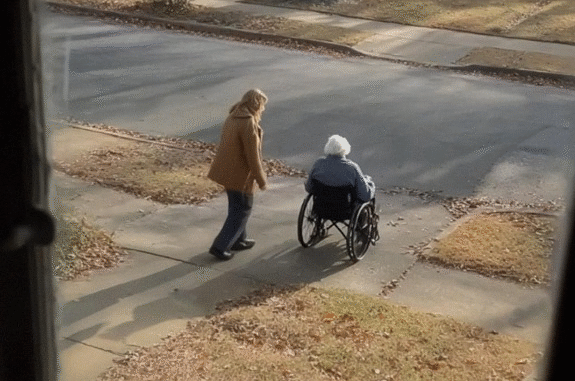
Hiring her felt like relief for all of us. Monday to Friday, and a short Sunday shift where she’d take Mom on slow walks around the block.
For the first few weeks, it was wonderful. Alyssa cooked actual meals, helped with exercises, kept the house organized, and treated Mom like a queen. Mom adored her. The neighbors adored her. Even I liked her—she was kind without being patronizing, patient in a way I couldn’t manage after a long day at school.
But over time, Sundays began to feel… strange.
Mom returned from their walks looking tense. Not upset—just troubled in a quiet, brittle way. When I asked how the walk was, she always gave the same too-bright answer:
“It was nice, honey.”
Except it clearly wasn’t.
Then one Sunday, she came in with her eyes red from crying. She didn’t say a word—just went straight to her room.
Alyssa gave me a quick smile. Too quick. “She walked farther today. She should rest.”
Something inside me whispered that wasn’t the whole truth.
We’d installed a doorbell camera at Mom’s house—mostly for safety and package theft. That night, long after Mark fell asleep, I opened the app. I found the recording from earlier that day.
The video showed Mom and Alyssa slowly approaching the door, Mom gripping her walker, Alyssa steady beside her.
Then I heard it—my mother’s voice, thin and trembling.
“I can’t hide this anymore. My daughter deserves to know what you told me.”
My heart lurched.
Alyssa’s reply was calm but almost pleading: “Not yet. You’re not ready to tell her. She might react badly.”
Mom’s breath shook. “She’s my daughter. I can’t keep this secret.”
Silence. Then Alyssa’s hushed answer:
“This could change everything.”
The clip ended. No explanation. No context. Just enough to send me spiraling.
I barely slept. By morning, my mind was racing: Was Alyssa manipulating her? Threatening her? Trying to isolate her? Mom had money—maybe this was a scam.
I waited for Sunday and sent Alyssa home early the moment she arrived. Then I went straight to Mom’s room. She looked up at me like she’d been waiting for this moment.
“Mom,” I said, “I heard the doorbell recording. What secret are you keeping from me?”
Tears filled her eyes instantly. “Oh, sweetheart… I’ve been so afraid to tell you.”
“Is Alyssa doing something? Is she pressuring you?”
“No,” Mom whispered fiercely. “She’s been nothing but good to me.”
“Then what is it?”
She took a breath that seemed to age her ten years. “It’s about your father.”
My stomach dropped.
“Your father had an affair before you were born,” she said quietly. “Just once, he told me. The woman had a child. A girl.”
The air around me vanished.
“You’re saying I have a sister?” I managed.
Mom nodded, guilt creasing her face. “Not far away. Right here. Alyssa.”
I felt the world tilt sideways.
“Alyssa,” I repeated. “The caregiver?”
“She found us after her mother died,” Mom said softly. “She didn’t want to come to you until she was sure. She… took a hair from your brush. For a DNA test.”
I just stared at her. “She took my DNA without asking? Mom—!”
“She feels terrible about it,” Mom insisted. “But she needed the truth before she disrupted your life.”
I swallowed hard. “And the test?”
“Honey… you’re half sisters.”
My father—my steady, dependable, gentle father—had kept a child secret. Had left her mother struggling while we thrived on the stability he never offered them.
I couldn’t decide if I was furious at him or heartbroken for her.
Mom wiped her eyes. “I’m giving her part of what your father left me. It’s only right.”
“What does she want from me?” I asked.
“To know you,” Mom whispered. “That’s all.”
That evening, when Alyssa returned, she wasn’t in scrubs. She looked nervous—young, vulnerable, bracing for impact.
“I’m sorry,” she said immediately. “I should’ve told you. I should’ve asked for the DNA. I just… I was afraid you’d reject me.”
I said the only thing that made sense: “We’ll do a new test. One I agree to. Then we talk.”
She nodded, relief flickering across her face. “Thank you.”
The second test came back the same.
Half sisters. Without question.
It’s been months since then. My emotions are still a tangled mess—anger at my father, sympathy for Alyssa, grief for what could’ve been, curiosity for what might be next.
But slowly, something unexpected is forming.
A relationship.
She still cares for Mom, but now she stays for dinner. She laughs with my kids. She tells me stories of her life, filled with hardships I never had to face.
It’s complicated. It’s messy. It’s real.
Family often is.
And sometimes, the person you hire to take care of your mother ends up being the sister you never knew you had—but maybe always needed.