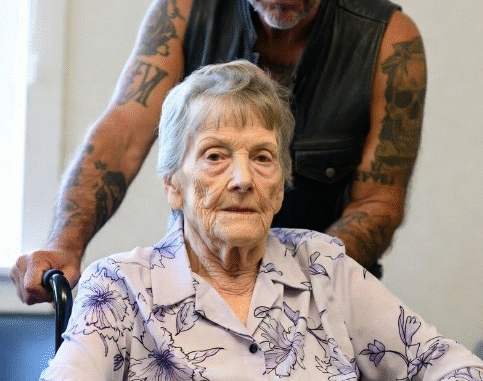
Dorothy Mitchell was eighty-seven, stubborn, and painfully lonely. Her children barely visited, her husband was long gone, and the revolving door of home-care nurses treated her like a list of tasks instead of a person. I lived across the hall and saw her growing quieter each month—less laughter, more silence.
Everything changed the day a tattooed, leather-vested giant of a man showed up at her door.
I rushed over, worried, but Dorothy grinned like she’d won the lottery. “This is Michael,” she announced. “My new helper. I fired the agency.”
Michael moved around her kitchen like he’d always belonged there—checking her meds, unpacking groceries, talking to her with real gentleness. They’d met at the grocery store after she accidentally whacked him with her cane, and something about him convinced her to give him a chance.
Two weeks later, her children stormed in, furious. “Mother, have you lost your mind?” they shouted. “A biker? In your home?”
They accused Michael of being dangerous, of taking advantage of her. He said nothing—until he pulled out an old photo of his mother, who’d died alone from Parkinson’s while he was living a rough life on the road.
“I wasn’t there for her,” he said quietly. “I can’t fix that. But I can be here for Miss Dorothy.”
The room fell silent. Dorothy took his hand and said, “He’s keeping a promise.”
Her children finally saw the truth: Dorothy wasn’t confused. She was happier than she’d been in years.
By evening, they were all sitting together around her small kitchen table, drinking tea and listening to her stories again. Michael stood by her chair, making sure her cup was warm and her hands steady.
Somehow, the tattooed biker she hired became the person who brought her family back together—and the one who gave her joy in her final years.
From across the hall, hearing her laugh again, I realized something simple:
Sometimes the person everyone judges is exactly the one who heals what’s broken.