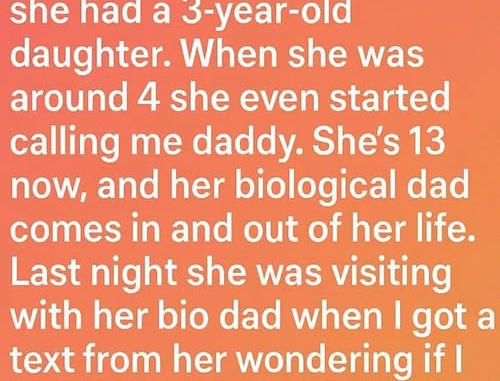
She was just three when our worlds collided—a tiny bundle with bouncing curls, wary wide eyes, and a stuffed giraffe so frayed it seemed to cling together out of sheer loyalty. On that first day, hiding behind her mother, I never imagined I’d become more than a friendly adult in her life. But by four, she started calling me “Daddy” on her own, naturally, like it was always meant to be. Now, she’s thirteen—a decade filled with scraped knees, bedtime stories, lost teeth, and countless inside jokes. A decade of fatherhood in every sense that mattered… except legally.
Then came a text that changed everything: Can you come get me? No emojis, no sugarcoating—just a plea. I drove to Jamal’s house, her biological father, my chest tight, hands gripping the wheel. She was already outside, backpack slung over her shoulder, jaw set as though she’d made this choice long ago. When she climbed in and quietly asked, “Can I call you Dad again? For real this time?” I didn’t hesitate. I nodded, swallowed hard, took her hand, and kept driving. That moment would stay with me forever.
I met her mother, Zahra, when Amira was still a toddler—sticky fingers, bedtime tantrums, cartoon-logic conversations. Her biological father was inconsistent, showing up with gifts but not presence, leaving with excuses instead of apologies. I never tried to replace him; I just… stayed. I showed up. First fevers, school plays, nightmares after scary movies. Even when she yelled across the kitchen, “Daddy, juice!” I didn’t correct her. Something settled silently that day, unspoken but real.
Things were steady until she turned ten. That’s when Jamal suddenly decided he wanted to “step up.” Courts, schedules, demands for weekends and holidays—it was all new. Amira, caught between worlds, stopped calling me “Daddy” and used my name instead—not out of rejection, just confusion. She drifted between us both, trying not to hurt anyone.
I stayed quiet, kept showing up. Breakfasts, school rides, science projects, soccer practice. I let her set the pace. Loving a child that deeply means taking the hits without complaint.
Then came last night—the text, the pickup, her question that broke through everything. She didn’t want to stay at Jamal’s anymore. At home, she revealed why: he had brought a new girlfriend over, introduced her without warning, kissed her in front of Amira, and she even called Amira the wrong name—twice. No anger, just deep hurt.
While helping her with a school project later, she quietly asked, “Why didn’t you ever leave?” I told her simply, “Because I never wanted to. You’re mine, and I love you.” She nodded, kept working, and understanding replaced confusion. By morning, her phone had my name saved as “Dad ❤️.”
Then came the legal challenge—Jamal’s lawyer petitioned for joint custody. Legally, I was nothing. But Zahra didn’t waver; she suggested adoption. When asked, Amira didn’t hesitate: “I want that.”
The adoption process was long and challenging. Jamal objected, claiming alienation. But professionals who spoke with Amira heard the same truth: she wanted stability, love, and the father who showed up—not the one who only said he would.
At the final hearing, the judge asked her what she wanted. Calm and resolute, she said, “I want Josh to be my real dad. He already is. He’s the one who stayed.” Six weeks later, the adoption was final. We celebrated simply—takeout, messy desserts, a favorite movie, and her leaning on my shoulder. “Thanks for not giving up on me,” she whispered. “Never crossed my mind,” I said, kissing her head.
The lesson is clear: family isn’t defined by DNA—it’s defined by commitment. The people who truly matter are the ones who show up—in emergencies, in quiet moments, in life’s daily grind. I’ve always been her dad. Now, the paperwork finally reflects it.
If you love a child who doesn’t share your last name—keep showing up. You’re shaping their world more than you know.