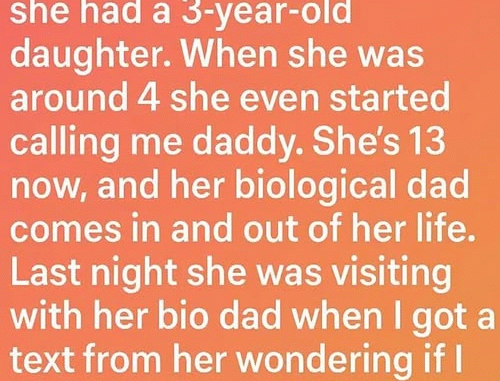
She was three when our paths first tangled—a tiny kid with bouncy curls, cautious eyes, and a stuffed giraffe so tattered it seemed to stay together out of sheer devotion. That first day, when she hid behind her mother’s leg, I never imagined I’d become anything more than another adult she barely knew. But by the time she turned four, she was calling me “Daddy” on her own. No prompting, no corrections. It came to her as naturally as breathing. She’s thirteen now. That’s ten years of bruised knees, bedtime routines, loose teeth, and jokes only we understand. Ten years of fatherhood in everything but legal terms.
Then last night, she sent a message that rearranged something in me: Can you come get me? No emojis, no fluff—just a request soaked in urgency. I drove to her biological father Jamal’s house with my chest tight. She was already outside, backpack slung over her shoulder, expression firm like she’d made up her mind long before she hit send. When she got in the car, buckled up, and whispered, “Can I call you Dad again? For real this time?”—I didn’t need words. I just nodded, squeezed her hand, and kept driving. That moment is burned into me.
When I met her mom, Zahra, Amira was still in full toddler chaos—sticky fingers, tantrums, nonsensical toddler conversations. Her biological dad drifted in and out, never when she needed him. He showed up with gifts instead of presence, disappeared with excuses instead of effort. I never tried to replace him; I just stayed. Consistency became my love language. The first fever, the first school play, the first nightmare after a movie too scary for her age. The day she shouted “Daddy, juice!” across the kitchen, I nearly dropped what I was holding. Zahra froze, waiting to see how I’d respond. I didn’t correct her. Something clicked into place right then.
Things were smooth until she turned ten. That’s when Jamal suddenly wanted to “step up.” He started talking about redemption, second chances, fatherhood. The courts got involved. A schedule was set—weekends, holidays, all the days he’d ignored before. We didn’t fight it; legally, we had no option. But watching Amira torn between guilt and disappointment was excruciating. She started calling me “Josh” again—not to push me away, but to try to make sense of the mess. She didn’t call him Dad either. She was just trying not to break anyone.
I kept steady. Breakfast together. School drop-offs. Science projects. Soccer practice. I followed her lead—distance when she needed it, closeness when she wanted it. Loving a kid like that means you absorb the hits quietly.
Then came last night’s text. Then the pickup. Then the truth in the morning over pancakes. Jamal had introduced a new girlfriend out of nowhere, then made out with her right in front of Amira. The girlfriend got her name wrong—twice. Voices were raised. Doors slammed. All of it sending the unmistakable message that Amira’s feelings didn’t matter. She told the story calmly, but her eyes said everything. She wasn’t mad—she was wounded.
Later, while we worked on her school poster, she asked, “Why didn’t you ever leave?” It stopped me cold. I told her, “Because I never wanted to. You’re mine. I love you.” She didn’t tear up or make a big gesture. She just nodded and kept gluing. The next morning, she changed my contact name to “Dad ❤️.”
Then came the envelope. A letter from Jamal’s attorney—petitioning for joint custody. Full weekends, holidays, decision-making power. Legally, I was nobody. A spectator in the life I’d been helping build for a decade.
Zahra didn’t hesitate. “If she wants it, we’ll start the adoption,” she said. We talked to Amira gently over dinner. “How would you feel if Josh adopted you?” Zahra asked. Amira blinked in confusion. “I thought he already did.” We told her it wasn’t official yet. She didn’t even pause. “I want that.”
The adoption process was endless forms, inspections, interviews, background checks—an entire binder of proof that I belonged in her life. Jamal protested. He accused us of alienation, theft. But every professional who spoke to Amira heard the same answer: she wanted stability. She wanted love. She wanted the parent who showed up—not the one who promised he would.
At the final hearing, the judge asked her, “What do you want?” She said, steady and sure, “I want Josh to be my real dad. He already is. He’s the one who stayed.” Something inside me loosened that day—ten years of quiet, unspoken fear.
Six weeks later, the adoption papers arrived. Final. Permanent. Done. We celebrated the only way that felt right: takeout, chaotic desserts, and her favorite movie. Midway through, she leaned against me and said, “Thanks for not giving up on me.” I kissed the top of her head. “I never even thought about it.”
If there’s anything to take from this, it’s this: DNA isn’t what builds a family. Commitment is. Family is made from showing up—in storms, in small moments, in the spaces where love becomes habit. I’ve been her dad for a long time. Now the world simply has the paperwork to acknowledge it.
And if you’re loving a child who didn’t start with your last name—keep going. You’re changing their life more than you realize.