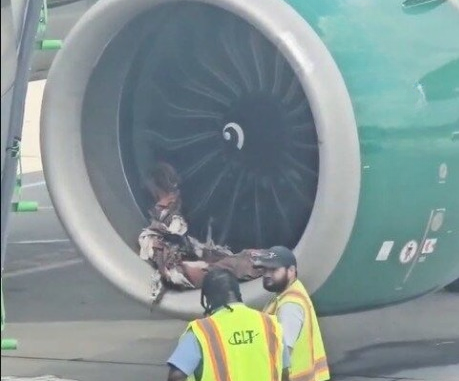
Terror at Charlotte Airport: Frontier A320 Ground Incident Causes Major Delays
On August 16, 2025, what began as a routine departure from Charlotte Douglas International Airport turned into a significant disruption when a Frontier Airlines Airbus A320 suffered engine damage during ground operations. The mishap, caused by a ground service air-conditioning hose being sucked into the aircraft’s engine, led to nearly nine hours of delays for passengers bound for New York, though no injuries were reported.
How It Happened
Flight F93134, an Airbus A320-251N (tail number N365FR), was preparing for its Charlotte-to-LaGuardia journey after arriving earlier from Philadelphia. During standard pre-departure procedures, a ground air-conditioning hose—used to regulate cabin temperature—was accidentally ingested by the CFMI LEAP-1A26 engine. The hose was shredded almost immediately, prompting crews to halt operations and ground the aircraft pending inspection.
Passenger Delays
Travelers were stranded while Frontier arranged a replacement plane, causing nearly nine hours of waiting. The airline emphasized that safety must take priority over schedule adherence. Eventually, passengers were rebooked on another aircraft and able to continue their journey.
About the Aircraft
The A320neo, introduced in 2019, features advanced engines like the LEAP-1A26, which generate strong suction even at low power. Ground hoses or other equipment near active engines pose a serious hazard, highlighting the importance of strict safety protocols. Early confusion over the aircraft model was later clarified: it was indeed an A320.
Why Engine Safety Matters
Engines are sensitive and costly components. Even minor foreign object damage (FOD) can require extensive repairs or replacements. While a shredded hose is less severe than metal debris, it still warrants grounding the aircraft. The incident also caused ripple effects on scheduling, as a single grounded plane can disrupt multiple flights.
Passenger Experience & Response
For travelers, the delay was stressful, but Frontier staff kept them informed and provided assistance. The event underscores the risks inherent in airport ramp operations, where multiple tasks—refueling, catering, maintenance—occur simultaneously. Vigilance and strict procedural discipline are essential to prevent accidents.
Airline and Industry Lessons
Frontier’s swift response, immediate grounding of the aircraft, and coordination for a replacement flight demonstrated a commitment to passenger safety. The incident reinforces the critical focus on foreign object damage prevention and the importance of prioritizing safety over convenience.
Conclusion
The Charlotte incident illustrates that while air travel is highly efficient and generally safe, unexpected challenges can arise. The Airbus A320 remains under maintenance review, and Frontier continues operations with a focus on safety. The episode serves as a reminder that in aviation, safety always comes first—even when delays inconvenience passengers.