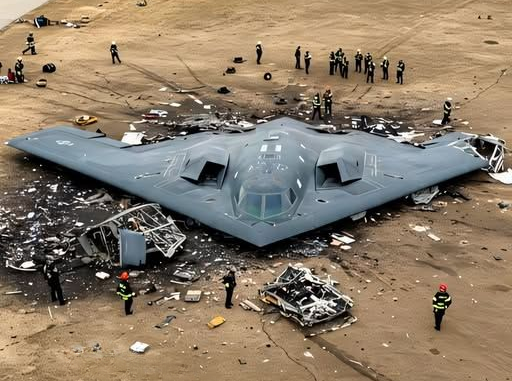
The B-2 Spirit stands in a league of its own—shrouded in secrecy, built with extraordinary engineering, and famous for being nearly invisible to hostile detection. Rumors have long circulated claiming one was shot down, but in more than thirty years of service, no verified incident has ever shown a B-2 being destroyed by enemy fire. What has occurred are a few rare accidents—serious, tragic, but never combat-related.
The most notable loss came on February 23, 2008, at Andersen Air Force Base. A B-2 attempting takeoff received corrupted data from moisture-damaged air sensors, leading the aircraft’s computer to misjudge its speed and angle. It lifted off too early, stalled almost instantly, and crashed back onto the runway. Both pilots ejected and survived, but the aircraft was destroyed. Investigators later concluded the crew made no mistakes—the cause was a software logic issue triggered by faulty sensor inputs.
Another significant mishap happened on September 14, 2021, at Whiteman Air Force Base, when a B-2 suffered a crash landing due to technical problems. Public details were limited, but the Air Force confirmed no hostile involvement despite widespread speculation. Like all complex machines, even the B-2 can experience failures.
These incidents underline that the Spirit, despite its cutting-edge design, is still vulnerable to technical errors. But when it comes to being shot down, the record is clear: no adversary has ever succeeded—and there are strong reasons why.
The B-2’s signature flying-wing shape scatters radar signals, while radar-absorbing materials make its radar cross-section unbelievably small. Engines buried deep within the wings help mask heat signatures. Advanced electronic warfare systems can jam or mislead enemy radars and missile seekers. Combined with high-altitude flight and careful mission planning that maps every threat on a route, the aircraft becomes extraordinarily difficult to detect, let alone target.
Modern air defenses struggle to track it; older systems have virtually no chance. This combination of stealth shaping, thermal management, electronic deception, altitude, and strategic routing allows the B-2 to penetrate heavily defended airspace without being challenged.
Throughout its operational history, the Spirit has flown dangerous missions without being touched by enemy fire. Though accidents have claimed a few airframes, no hostile force has ever brought one down. Given its capabilities, the odds remain extremely low.
The B-2 endures not as a myth, but as a testament to advanced engineering and strategic design—a machine that redefined the meaning of stealth and continues to shape the future of aviation.