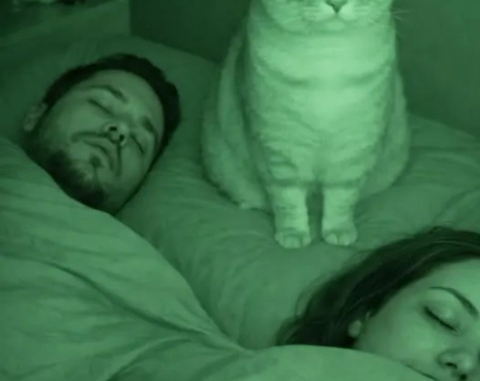
Life with pets often flows in quiet, predictable rhythms—the soft padding of paws, a gentle purr at the foot of the bed, and a wordless companionship that soothes rather than speaks. Our cat, Luna, had always embodied this calm. Elegant, intelligent, and disciplined in her routines, she had her own plush bed by the wall, rising only when sunlight touched the floorboards. Yet, a subtle change began to creep in at night, turning our bedroom from a peaceful retreat into a source of unease.
It started as a prickling sensation at the back of my neck—a feeling that we weren’t entirely alone in our dreams. I would drift into sleep, only to be pulled awake by the sense of a silent, unwavering gaze. At first, I dismissed it as a half-remembered dream. But then I forced my eyes open. There was Luna, no longer curled in her bed but sitting on the edge of my pillow, her golden eyes locked on us with unnerving intensity. In the moonlight, she seemed less like a domestic pet and more like a small, shadowy sentinel.
By day, Luna remained her familiar, affectionate self. She ate, napped, and basked in the sun as always. But at night, her demeanor shifted. She became a vigilant observer, staring at us with a precision that bordered on predatory. The nightly “watching” sessions increased, leaving me dreading bedtime. My imagination wandered toward the supernatural—was she sensing something we couldn’t, or was she simply waiting for… something?
Concerned, I took her to the vet, describing her unusual behavior. After a thorough check, the vet assured me Luna was perfectly healthy. Perhaps she was stressed or bored, the vet suggested, noting that cats are naturally more active at dawn and dusk. This advice was logical—but how could we monitor a cat while asleep? I set up a night-vision camera to capture the bed overnight.
The footage revealed the truth: around 2 a.m., Luna would leave her bed and move with deliberate grace onto ours. She would sit inches from my husband’s face, staring silently for nearly forty-five minutes, her head cocked as though analyzing an intricate puzzle. Then, when his snoring escalated to a thunderous rumble, Luna intervened. With uncanny precision, she placed a paw over his mouth, stifling the noise just enough to restore peace. Satisfied, she would retreat to her own bed, curling up to sleep.
The realization was both hilarious and enlightening. Luna wasn’t a sinister watcher; she was a tactician, a tiny enforcer of nighttime tranquility. Her “staring” was a method of monitoring for the exact moment she needed to act—a feline solution to the problem of my husband’s snoring.
Now, we view Luna’s nightly vigilance with amusement rather than fear. My husband has even started using nasal strips to lighten her workload. Our cat isn’t haunting us—she’s preserving the quiet she values, taking her role as bedroom guardian seriously and with a touch of ingenuity.
The camera showed us that what initially seemed eerie had a logical, endearing explanation. Luna’s nighttime routine reminds us that pets communicate and interact with us in ways we don’t always understand, and sometimes their “strange” behaviors are acts of care disguised in the language of fur and paws. Our bedroom remains under surveillance, but now it’s comforting to know the watchful eyes belong to a devoted guardian who simply wants a little peace and quiet.