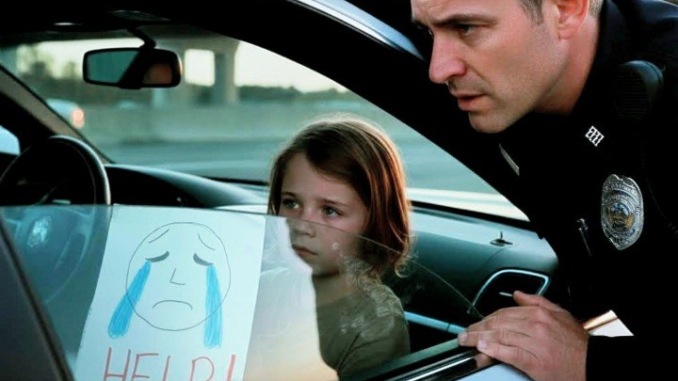
Officer Daniel Brooks had spent twelve years on the force—long enough to know that danger isn’t always obvious. Sometimes it hides in silence.
Just after six one evening, he noticed something unusual on the back window of a moving sedan: a childlike drawing of a crying face, and beneath it, written in shaky red letters, one word—HELP.
He didn’t panic, but his instincts kicked in. The drawing vanished, but the feeling in his gut didn’t. Daniel followed the car at a distance. No traffic violations. No sudden moves. Still, something felt wrong.
The sedan exited the highway and stopped at a rundown house. The driver got out and headed inside—without checking on the child in the back seat.
Daniel approached. When he asked about the child, the man grew defensive. Then Daniel heard it: a muffled sob from inside the car.
That was enough.
Backup was called. The man tried to flee but was quickly caught. Daniel rushed to the car and opened the back door.
Inside was a frightened little girl, clutching paper and crayons.
“He said he was taking me home,” she whispered. “But that’s not my home.”
Her name was Lily. She had used the only tools she had—crayons and courage—to ask for help.
The man turned out to be her mother’s former boyfriend who had taken her from school by lying. Lily’s message had saved her.
When her mother arrived and held her again, the moment said everything.
Later, the mother thanked Daniel.
“She saved herself,” he replied. “I just paid attention.”
Heroism isn’t always loud.
Sometimes it’s a child, a drawing, and one small word—HELP—seen by someone who chose to follow.