Emma was only three when her biological father died. I was twenty-seven, suddenly widowed, trying to survive grief while raising a child who couldn’t understand why her life had changed. For a long time, it was just the two of us facing the world together—quiet mornings, forced smiles, and a space at the table we never spoke about.
Years later, when Daniel entered our lives, I was clear from the start.
“You don’t get a relationship with me unless you accept her.”
He never hesitated.
Daniel didn’t slowly ease his way into Emma’s world—he stepped in fully. He learned how to braid her hair (with questionable results), packed her school lunches, helped her through math problems, and cheered louder than anyone at school performances. To him, she was never a “step.”
She was his child.
Daniel’s mother, Carol, saw it differently. From the beginning, she treated Emma as someone who existed just outside the boundaries of family.
Once, while stirring her tea, she remarked casually, “It’s sweet that you both act like she’s really yours.”
Another time, I overheard her mutter, “Blood is what makes a child belong.”
We reduced contact. Stayed polite. Swallowed our anger.
Until one winter, when Carol crossed a line that could never be erased.
A Child’s Decision to Be Kind
As December approached, Emma told me she wanted to help children spending the holidays in hospice care.
“I want to make them hats,” she said one morning, still in cat-print pajamas. “So they don’t feel lonely.”
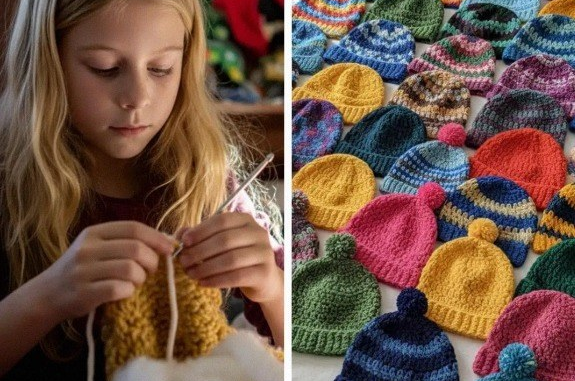
She taught herself to crochet through online videos. She saved her allowance to buy yarn. Every afternoon after school, she curled up on the couch, carefully stitching while humming Christmas songs.
Each hat was unique—bright colors, soft pastels, pom-poms, uneven stitches—every one filled with pure intention.
By the time Daniel left for a short business trip, Emma had finished seventy-nine hats and was halfway through her final one.
That was when Carol showed up.
The Day Everything Fell Apart
Emma and I returned from the store, and she ran ahead to her room, eager to pick yarn for her last hat.
Seconds later, I heard her scream.
I rushed in.
The bag holding the hats was gone. The space under her bed was empty. Weeks of effort had vanished.
Behind us, a spoon tapped gently against a teacup.
Carol stood in the doorway, calm and unbothered.
“I threw them away,” she said lightly. “Children shouldn’t waste time on people they don’t know. And honestly, they weren’t very nice.”
Emma stared at her, voice shaking. “They weren’t bad.”
Carol shrugged. “The colors didn’t match. The stitches were sloppy. And she’s not my blood—why should she represent this family?”
That was when I understood there are different kinds of cruelty. Some scream. Others sip tea while a child breaks in front of them.
I held Emma until she cried herself to sleep. I searched every trash bin. The hats were gone.
Carol hadn’t just thrown away yarn.
She tried to erase a child’s kindness.
When Daniel Came Home
The next day, Daniel walked through the door and asked, “Did we finish all eighty?”
Emma collapsed into tears.
I told him everything.
Something hardened behind his eyes—not rage, but certainty.
“I’ll handle it,” he said.
Two hours later, he returned filthy and exhausted, holding a large black garbage bag.
Inside were all eighty hats—dirty, wrinkled, but still there.
He called his mother. “Come over. I want to show you something.”
Carol arrived irritated, not apologetic.
Daniel opened the bag. She looked—but said nothing.
“I spent an hour digging through dumpsters,” he said evenly. “Because those hats weren’t trash—only you treated them that way.”
That’s when she said the words that ended everything.
“She’s not your daughter. Stop pretending.”
Daniel didn’t raise his voice.
“She is my daughter,” he said. “And you will not be part of her life anymore.”
“You’re choosing them over your own mother?” she snapped.
“Yes,” he replied instantly. “Without hesitation.”
Rebuilding What Was Almost Lost
The next day, Daniel came home with bags overflowing with yarn, hooks, ribbons, and tags.
“If you want to make them again,” he told Emma, “I’ll learn with you.”
She laughed for the first time since it happened.
They worked together every evening—his stitches clumsy, hers confident—threads crossing the way real families do.
When the hospice shared photos of children wearing the hats, the post spread quickly online. Emma commented proudly:
“My dad helped me remake them after my grandma threw the first ones away.”
The response was immediate.
Carol called—not to apologize, but to complain.
Daniel answered calmly, “We didn’t create the truth. We just stopped hiding it.”
Now
Carol still sends polite messages on holidays, asking if it’s time to “heal the family.”
Daniel gives the same reply every time.
“No.”
Because healing requires remorse, accountability, and change. She offered none.
These days, our evenings are filled with the soft click of crochet hooks, shared laughter, and quiet lessons in patience and love.
When I watch Emma lean against Daniel, guiding him through yet another stitch, I know this:
Biology may create relatives.
But love creates family.
And Emma has a father—not by blood, but by choice.