I used to imagine the end of my marriage would be dramatic—filled with arguments, explanations, maybe even loud goodbyes. I expected closure wrapped in confrontation or slammed doors.
Instead, it ended quietly.
One day he was part of our daily life, and the next, he was gone. No long conversations. No attempts to repair what we had built. No explanations. Just absence—sudden, clean, and devastating.
I was left alone with two children and a future that suddenly depended entirely on me.
Those early years were relentless. Every decision, every expense, every sleepless night mattered. There was no safety net, no one to share the weight. I learned to carry responsibility quietly because no one else would.
I worked. I parented. I listened. I stayed calm despite exhaustion pressing into my bones. Slowly, almost imperceptibly, I stopped waiting for him to return. I stopped hoping for apologies that would never come.
I didn’t heal by forgetting what had happened. I healed by adapting.
Time softened the sharpest edges. My children grew stronger. So did I. The pain didn’t vanish, but it became something I could manage rather than something that controlled me. I truly believed that chapter was closed.
Then one afternoon, the doorbell rang.
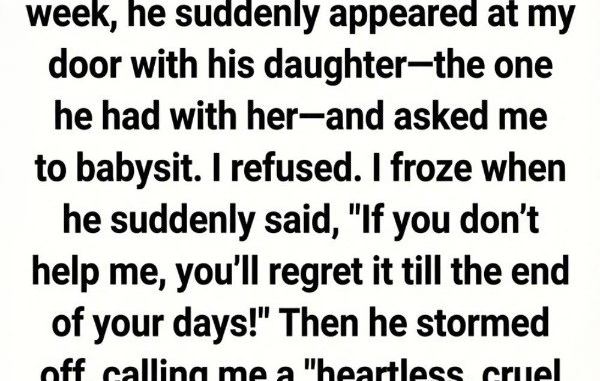
When I opened it, he stood there as if no years had passed. Beside him was a young girl, no older than seven or eight, holding his hand—his daughter from the life he had chosen after leaving ours.
He asked casually, as if nothing had changed, if I could watch her for a while. Just temporarily.
I didn’t feel anger. I felt stunned.
I looked at the child—innocent, unaware of the history she had stepped into—and then at him. I remembered the nights I worried alone, the birthdays he missed, the strength I had built without him. In that moment, I understood something crucial: I didn’t owe him anything.
So I said no.
Not harshly, not cruelly—just honestly. I told him my life was full, that I had boundaries, that I couldn’t take on that responsibility.
His reaction was immediate. He accused me of being heartless, lacking compassion. Then he left, holding the child’s hand, and the door closed. The silence returned, heavier this time.
For days, I questioned myself. Could I have said yes for the child’s sake? Was I being unfair?
But as weeks passed, the doubt faded. I realized that protecting my peace didn’t make me unkind—it made me honest.
Two months later, his wife called. Calm, respectful, apologetic. She acknowledged the position I had been put in, the assumption that I would say yes, and recognized the life I had rebuilt. The call was brief, but it mattered.
When it ended, I felt a quiet closure—not because everything was fixed, but because I had learned something essential:
Strength isn’t loud.
It isn’t dramatic.
Sometimes, it’s simply knowing when to say no—and trusting that you don’t need permission to protect the life you worked so hard to rebuild.